
Happy Chinese New Year! … Or maybe happy Lunar New Year? For many people, it might not be clear what exactly the difference between the two holidays are. Don’t worry, though, it’s normal to be confused. After all, Chinese New Year is, effectively, Lunar New Year. It’s just that the Lunar New Year isn’t always Chinese New Year. It’s kind of like with shapes: all squares are rectangles, but not all rectangles are squares – in fact, some rectangles might consider it rude to be called squares.
To give you a better understanding of what makes the holiday “Chinese New Year” versus “Lunar New Year” and help you avoid accidentally offending anyone during one of east Asia’s most important festivals, here’s our guide to everything you need to know about the holidays.
Content Preview
- Core Differences Between Chinese New Year and Lunar New Year
- Lunar New Year vs Chinese New Year Controversy
- How Different Countries Celebrate: Traditions Compared
- When to Call It “Chinese New Year” or “Lunar New Year”?
- Greetings & Phrases in Different Language
- Comparison of Key Elements in Different Countries
- FAQs about Chinese New Year and Lunar New Year
- Experience Chinese New Year with Us
Core Differences Between Chinese New Year and Lunar New Year
What is Chinese New Year? – A Specifically Chinese Celebration
Chinese New Year is, unsurprisingly, the celebration of the Lunar New Year in the Mainland of China, Hong Kong, Macau and Taiwan. This term emphasizes more of the cultural origin. The holiday starts on the first new moon of the lunar calendar and lasts for 15-16 days, depending on whether you count Chinese New Year’s Eve. Each year is associated with a different animal and element, and celebrations typically revolve around spending time with family and inviting good fortune in the coming year.
See also: Chinese New Year Celebrations 2026 – A Day by Day Guide
What is Lunar New Year? – A More Inclusively Asian Holiday
Lunar New Year is a broader term that refers to all celebrations of the Lunar New Year, not just culturally Chinese ones. Korean, Japanese, Vietnamese, Singaporean, and other countries’ celebrations can all be referred to as Lunar New Year celebrations, but not as Chinese New Year Celebrations. Even though the holidays start on the same dates and share some similar attributes, there are many differences between them.

Distinguishing Traditions: Shared Customs vs. Unique Practices
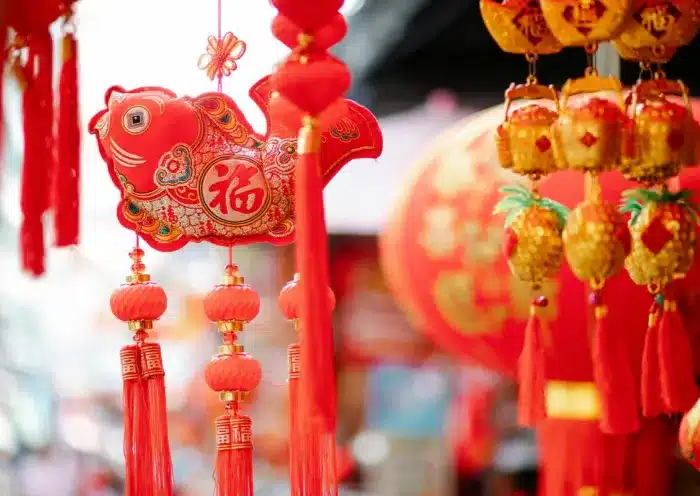
As we mentioned, both Chinese New Year and Lunar New Year typically start at the same time, typically between late-January and mid-February. Both holidays also have similar themes, like family, good fortune, and the colour red. Additionally, most countries associate each year with a Zodiac sign and emphasise spring cleaning before the arrival of the new year.
Beyond that, though, each country has different celebrations that align with their own cultures, such as the number of days that the holiday is celebrated. In Korea, for example, the Lunar New Year celebration lasts 3 days, only a fifth as long as in China. The food people eat, the traditions they follow, the names of the holidays, and even the Zodiac animals can also be different in different countries.
The Dates of Chinese New Year and Lunar New Year Can be Different
While Chinese New Year and Lunar New Year are almost always celebrated on the same dates, there can be some variation. This is typically due to different ways of calculating the new moon’s arrival or as a result of time differences. For example, if the new moon is officially seen at 11:30pm in China, it’s already 12:30am in Vietnam, so there would be a one-day difference in the start of Lunar New Year celebrations in each country.
Chinese New Year vs Lunar New Year: Side-by-Side Comparison
Chinese New Year |
Lunar New Year |
|
Dates |
Late-January to Mid-February |
Late-January to Mid-February |
Who Celebrates |
China, Hong Kong, Taiwan, Macau, Chinese diaspora |
Also Korea, Japan, Vietnam, Malaysia, Singapore, etc |
Cultural Scope |
Chinese traditions such as red packets, fireworks, etc |
Multicultural traditions; food, for example, varies with bánh chưng in Vietnam, tteokguk in Korea, and spring rolls in China |
Lunar New Year vs Chinese New Year Controversy
The usage of “Chinese New Year” and “Lunar New Year” is part of an ongoing controversy. These two terms reflect a diverse preference for emphasizing either a specific cultural origin or broader inclusivity.
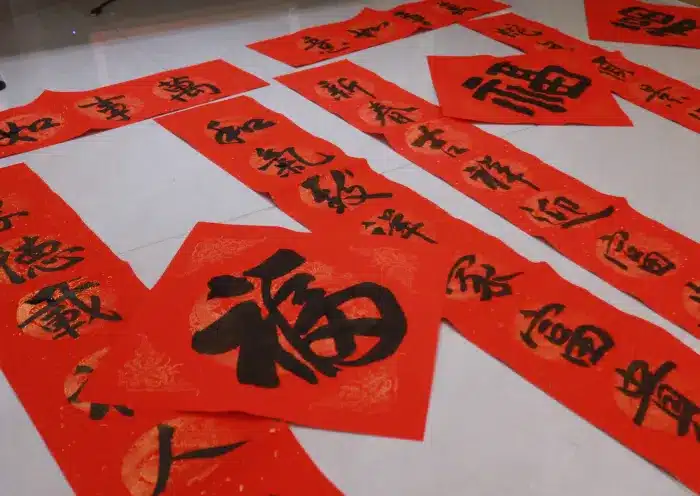
Some people feel that the term “Chinese New Year” can be sensitive, as various other cultures also celebrate similar festivals (with different names) on similar dates.
While the term “Lunar New Year” also faces debate due to its literal meaning not perfectly aligning with the actual lunisolar calendar it represents. Not based solely on lunar phases, the festive is actually governed by the Chinese lunisolar calendar, which incorporates both lunar cycles (Yin) and the Earth’s orbit around the sun (Yang).
It’s worth noting that, when listing the festival as intangible cultural heritage, UNESCO adopted “Spring Festival” as its standard English translation. This is another commonly used name of this festival.
Learn more interesting things to know about Chinese New Year.
How Different Countries Celebrate: Traditions Compared
Now that you know the basics of Chinese New Year versus Lunar New Year, here’s a more in-depth look the customs and celebrations of the holiday in four different countries.
China: Spring Festival, aka Chūnjié (春节)
Given how often the Lunar New Year is referred to as Chinese New Year, it won’t come as a surprise that many of its traditions are so well known. Spring Festival is a long holiday in China, so there are too many foods associated with it to cover here, but it’s important to know that a major part of the holiday is spending time with family and enjoying reunion dinners together. Those meals are also an occasion for older family members to give younger family members red packets, aka hóngbāo, full of money, though you can also give CNY gifts to friends as well.
If you travel to China during this time of year, you can expect to see lots of red decorations everywhere, and you might even catch a dragon or lion dance if you’re lucky. Don’t be surprised if you hear a lot of loud bangs, either – many households set off fireworks and firecrackers to scare off evil spirits.
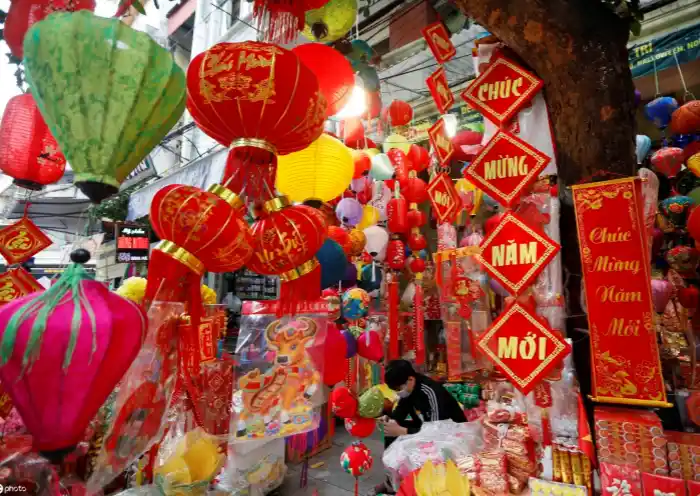
Vietnam: Festival of the First Day, aka Tết Nguyên Đán (節元旦)
In Vietnam, the most important foods for Tết are bánh chưng and bánh tét. These are rice cakes, the former of which is square to represent the Earth while the latter is circular to represent the moon. Celebrations can last anywhere from 5-10 days, and the festivities place emphasis on harmony and new beginnings. Many families will set up altars for their ancestors during this time, and decorations often feature peach blossoms, apricot blossoms, and kumquat trees. Older family members also give red packets called lì xì to younger family members, similar to the custom in China.
One particularly interesting part of Tết celebrations is the custom of xông đất, the first visitor of the year, which determines the family’s luck for the new year. Families will often deliberately invite a successful person with a good personality and auspicious zodiac sign to come over after midnight and fill this role.
Korea: Lunar New Year, aka Eumnyeok Seollal (음력 설날)
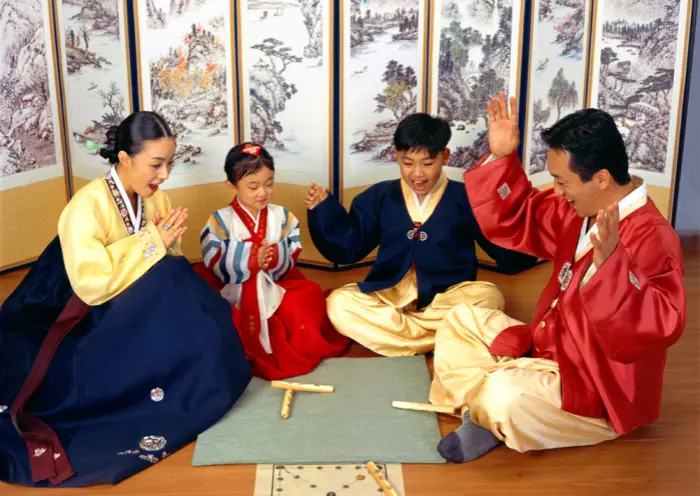
While there are some things in common, such as reunion dinners, cleaning, and ancestor worship, many aspects of Seollal are significantly different from Tết and Chūnjié. For example, fireworks and firecrackers aren’t a major part of the celebration, and you won’t find any dragon or lion dances either, though you may see people wearing traditional Korean hanbok. Instead of setting up an altar for ancestors like during Tết, families typically leave out a table of ritual foods on the morning of the Seollal. Additionally, while elders give children money during Seollal as well, it’s in a white packet rather than a red one.
One of the more interesting aspects of Seollal is that it’s seen as the day when everyone gets one year older, which is symbolised by eating tteokguk, a rice cake soup. There are also a variety of traditional games played during the holiday.
Singapore: Fusion Traditions
As a multicultural society, it’s no surprise that Singapore’s Lunar New Year celebration is full of diverse practices. While its core lies in Chinese customs as a result of the country’s large Chinese diaspora, people from Malay, Indian, and other ethnic communities also join in their neighbours’ celebration. As a result, during the annual Chingay Parade during the Lunar New Year, you’ll see Chinese dragon and lion dances, Malaysian dancers, Indian drummers, and more.
One of the most popular dishes enjoyed in both Singapore and Malaysia during the new year is Yusheng, also known as Prosperity Toss, a unique salad made of raw fish.
When to Call It “Chinese New Year” or “Lunar New Year”?
When “Chinese New Year” is Appropriate
If you’re referring specifically to Chinese celebrations of the Lunar New Year, it’s perfectly appropriate to call it Chinese New Year.
When “Lunar New Year” is More Inclusive
If you’re speaking to a group of people with mixed or unknown cultural identities, it’s best to wish them a happy Lunar New Year. Better yet, if you know where they’re from, you can look up what the typical greeting is for their country’s Lunar New Year celebration.
Greetings & Phrases in Different Language
Language |
Greetings & Phrases |
Pronunciation |
Mandarin |
新年快乐! |
Xīnnián kuàilè! |
Mandarin |
恭喜发财! |
Gōngxǐ fācái! |
Mandarin |
身体健康! |
Shēntǐ jiànkāng! |
Cantonese |
新年快乐! |
San1 nin4 faai3 lok6! |
Cantonese |
恭喜发财! |
Gung1 hei2 faat3 coi4! |
Cantonese |
龙马精神! |
Lung4 maa5 zing1 san4! |
Korean |
새해 복 많이 받으세요! |
Saehae bok mani badeuseyo! |
Korean |
건강하세요! |
Geonganghaseyo! |
Korean |
행운 가득하세요! |
Haengun gadeukaseyo! |
Vietnamese |
Chúc mừng năm mới! |
Chook moong num moy! |
Korean |
An khang thịnh vượng! |
An khang thinh vuong! |
Korean |
Vạn sự như ý! |
Van su nhu y! |
Comparison of Key Elements in Different Countries
Aspect |
China |
Vietnam |
Korea |
Local Name |
Spring Festival (春节) |
Tết Nguyên Đán (節元旦) |
Eumnyeok Seollal (음력 설날) |
Main theme |
Family reunion, welcome the new year |
Show grate to ancestors and welcome the spring with blessings. |
Worship the ancestor |
Key Foods |
Dumplings, fish, rice cake |
Square zongzi, pickled scallion, glutinous rice cake |
Rice cake soup, grain rice and roasted meat |
Money Gift |
Red envelope |
Red envelope |
White envelope |
Unique Customs |
Paste Spring Festival couplets, set off firecrackers, watch the Spring Festival Gala, temple fairs, and dragon and lion dances |
Place kumquat bonsai and peach blossoms, and on New Year’s Eve, break branches |
Play Yutz game, wear Hanbok, and drive away the “Luminous Ghost” |
Duration |
15 days |
7 – 9 days |
3 days |
FAQs about Chinese New Year and Lunar New Year
Is Chinese New Year and Lunar New Year the same?
They are not the same. Chinese New Year is unique to China, while the Lunar New Year is a more inclusive festival that is celebrated in many Asian countries.
What is the fundamental difference between Chinese New Year and Lunar New Year?
Chinese New Year emphasizes its cultural attribute to China, while the Lunar New Year does not have any national attribute.
Is it more accurate to call the holiday “Spring Festival” (Chūnjié)?
Yes. Spring Festival is the official English name recorded in the UNESCO Intangible Cultural Heritage List.
Do all cultures celebrating the Lunar New Year use the same Zodiac animal cycle?
The zodiac animal cycle originates from China, so the core sequence is basically same in all culture. But there may be slight differences in animals. For instance, the rabbit is replaced with cat in Vietnam culture.
Is “Chunyun” (the massive travel period) specific only to China’s celebration?
Yes, it is a specific phenomenon in China only.
Experience Chinese New Year with China Xian Tour
With the basics of Chinese New Year versus Lunar New Year now covered, the best way to get an even deeper understanding of the holiday is to experience it in person. Luckily, we here at China Xian Tour already offer tours for anyone looking to celebrate the holiday. Whether you want to check out beautiful lanterns, need some ideas for activities to do during Spring Festival, or are just looking for somewhere interesting to travel, we’ve got you covered. Even better, we also offer custom tours to suit every traveller’s needs and preferences, so if you have something specific in mind, we’re happy to help. So what are you waiting for? Plan your Chinese New Year holiday with us!