Xian is the ancient capital for 13 Chinese dynasties, among which Qin, Han and Tang dynasties have the most interesting history, leaving profound cultural deposits. For an in-depth understanding of the Qin history, it is inevitable to start with the Terracotta Warriors (Terracotta Army), which is the most famous scenic spot in Xian.
In September 1987, Jacques Chirac, the former President of France, rated the Terracotta Warriors as “the eighth wonder of the world”. What is so fascinating and so great about the Terracotta Warriors? Let’s learn some fun facts about the Terracotta Army in China.
1. The Terracotta Warriors Served as Burial Objects for Qin Shi Huang
“Terracotta figures” refer to burial dolls. Before the Qin Dynasty, nobles often used real people to be buried with the dead. In the Qin Dynasty, it was abolished and replaced with terracotta figures.
The Terracotta Warriors of the First Emperor of Qin were planned and designed under the leadership of the Prime Minister Li Si. After 39 years, the Terracotta Army was finally completed together with the Mausoleum of Qin Shi Huang (one of the cool facts about the Terracotta Army in China).
Therefore, the Terracotta Warriors we see today are not made by real people, but are actually the terracotta products. They represent the underground army of Qin Shi Huang.
2. The Terracotta Warriors were Discovered Occasionally
An interesting fact about the Terracotta Army is its discovery. In 1974, when several farmers were digging a well 1.5 kilometers east of the Mausoleum of Qin Shi Huang in Lintong, Shaanxi Province, they accidentally unearthed fragments of the terracotta figures.
The Qin Terracotta Army, dormant for more than 2,200 years, has finally come to light. And it has shown no signs of being stolen ever. This discovery shocked the world and unveiled the mystery of China’s largest archaeological site.
3. The Terracotta Warriors Museum is mainly composed of three pits.
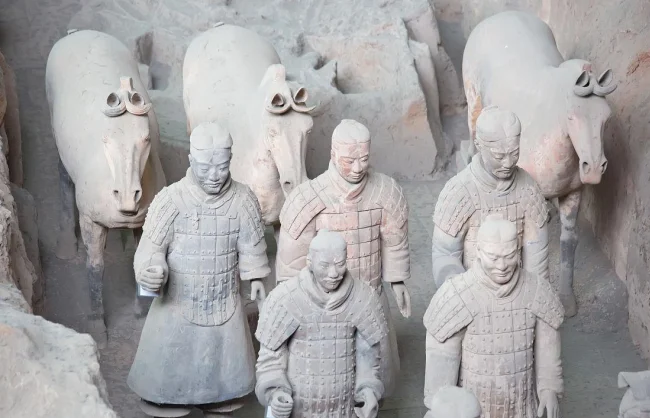
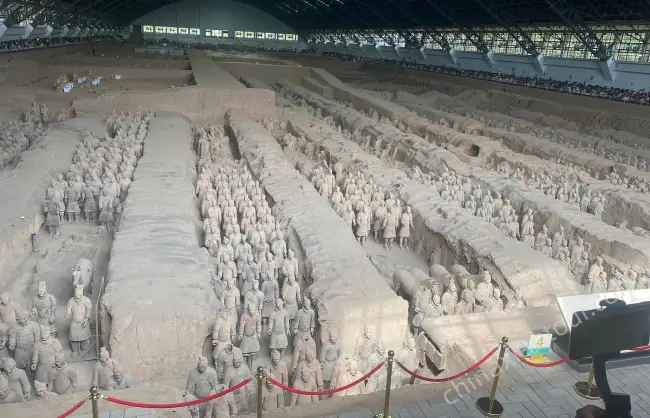
After 50 years of archaeological excavation, the total area of Terracotta Warriors pits 1, 2 and 3 exceeds 20,000 square meters, which is a cool fact about the Terracotta Army in China.
Pit 1 is the largest with over 2,000 terracotta warriors and horses arranged in a strict military array layout. Pit 2 is a valiant and heroic combat troop, so it was of more appreciation value. It has not been fully excavated till now. Pit 3 is the smallest with only about 60 terracotta figures. It is said this pit is a battle headquarters and the commander is likely to be the Emperor Qin himself.
4. There are Mounds in the Middle of the Terracotta Warriors
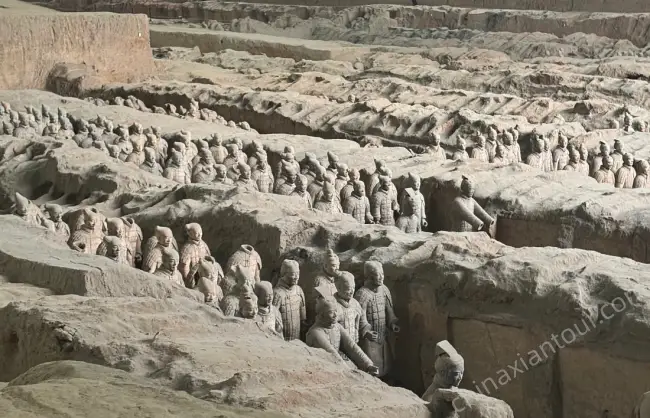
During the Terracotta Warriors tour, many tourists find that every few rows of Terracotta Warriors are separated by mounds. Why is it?
In fact, this is mainly related to the building of the Terracotta Warriors. The middle mound is the rammed earth wall when the burial pit was built, which is equivalent to the load-bearing wall of the house now, and is harder than bricks.
These mounds can well prevent the collapse of the burial pit. At that time, when building the mausoleum, mounds were built every few meters, and then the Terracotta Warriors were successively displayed in the burial pit, covered with wood and mats, and finally filled with rammed earth.
5. There are Diverse Types of the Terracotta Warriors
Since the discovery of the Terracotta Army, more than 8,000 lifelike terracotta figures have been unearthed, including warriors such as military officers, standing archers, kneeling archers, cavalrymen, infantry and charioteers, 130 chariots and 670 horses. According to excavated records, the number of infantry warriors is the highest, accounting for over 80% of the total.
An interesting fact about the Terracotta Army: In the newly excavated pit, in addition to the terracotta warriors, there are also acrobatic performers, singers, dancers and attendants, as well as a large number of birds such as waterfowl, cranes and ducks that have never appeared before.
6. Each of the Terracotta Warriors is unique.
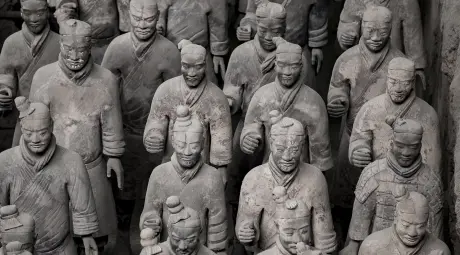
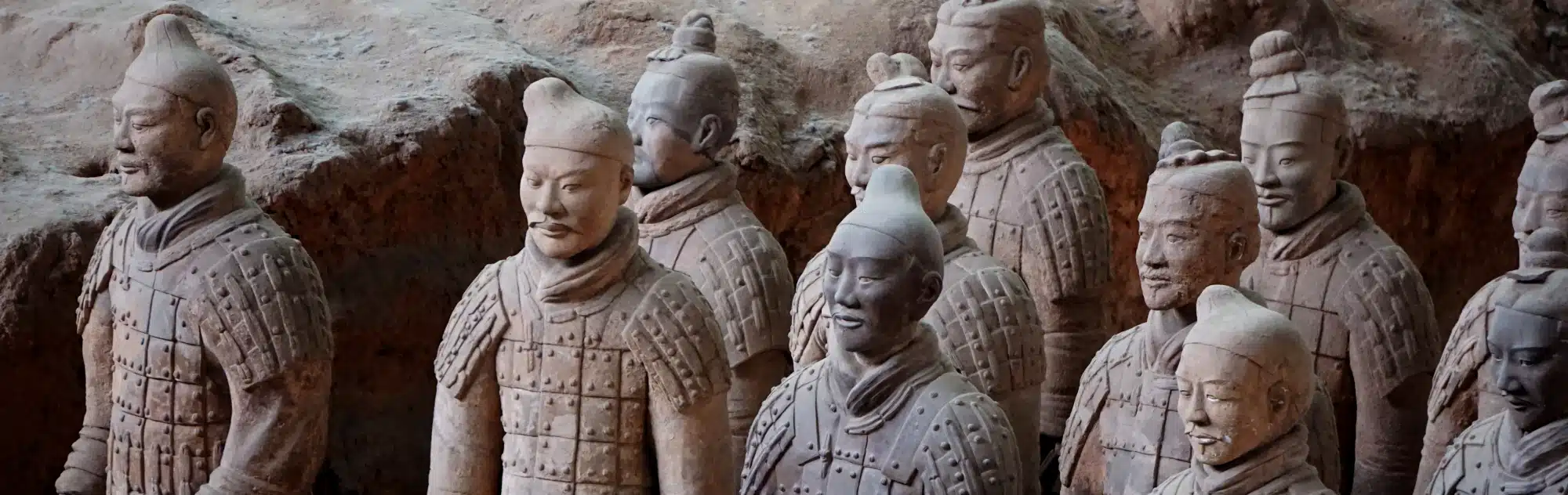
The large number of Terracotta Warriors is not surprising, but if you look carefully, you will be amazed to find that the Terracotta Warriors all look not exactly the same from each other.
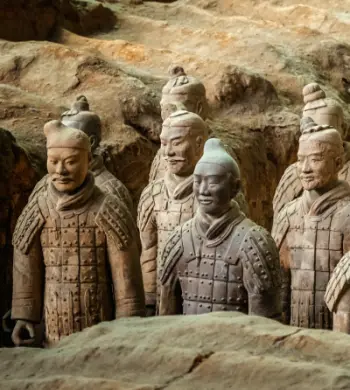
A fun fact about the Terracotta Warriors is that each figure has unique facial features. According to the experts, their facial features can be divided into at least eight different facial types.
Their expressions, demeanor, clothing, and hairstyles are all different. Hairstyles and head-wear can reflect their identity level, for example, ordinary soldiers do not wear crowns and have slanted hair buns; the crowns worn by military officers of different ranks are also different.
-
The Production of the Terracotta Warriors:
Terracotta Warriors were made by excellent craftsmen, who gave life to them with their wisdom and talents! The production process of the Terracotta Warriors is very complex, and each figure is made in sections. First, the head, torso, and limbs are formed separately, and then combined for carving and coloring.
The hand shape of each soldier, the chariot wheels, the mane of horses, etc., are all finely designed and clearly depicted. The Terracotta Army not only shows the grand scale and super-high craftsmanship of the Mausoleum of Qin Shi Huang, but also reveals many details of the military, cultural and social life of the Q
7. The Terracotta Warriors were in color when unearthed.
The Terracotta Warriors we see today are all earthly yellow. However, they were colored when unearthed, some with black eyes, and some with taupe eyes. The clothes of various Terracotta Warriors also have different colors. Archaeologists have discovered over 10 types of colors, among which vermilion, blue, and green are the most common.
One fact about the Terracotta Army in China: During excavation, the colored paint layer on the surface of terracotta figures curled up after being exposed to the air for only 15 seconds, and peeled off within 4 minutes, eventually becoming the appearance we see during Xian travel today.
8. The Weapons of the Terracotta Warriors Are Missing
A fun fact about the Terracotta Army is that the weapons in the Terracotta Warriors were real bronzes rather than models. However, most of the Terracotta Warriors seen today have a holding gesture but they do not have weapons in their hands.
The weapons in the hands of the Terracotta Warriors may disappear due to corrosion or looting. One speculated reason is that the handle of the weapon is made of wood, and the iron head buried underground for too long causes corrosion. Another reason is that the weapons were looted or destroyed by Xiang Yu.
9. The Terracotta Warriors are All with Single Eyelids
One fact about the Terracotta Army is that the Terracotta Warriors are all with single eyelids, which may be related to the ethnic and national characteristics at that time. The Terracotta Warriors are all imitations of real people, which proves that the pure Han people in the Qin Dynasty are all single eyelids.
In the Qin Dynasty, the single eyelid was the standard for handsome men, which was also the earmark of pure Han people’s appearance. And people with single eyelids have a cold and serious expression, which may better meet the needs of military roles.
.jpg)
10. Over 160 Million Tourists Have Visited the Terracotta Warriors
Some people may consider it hard to be obsessed with those gray figures, however, what’s incredible is that the tourist amount of Terracotta Warriors had ever reached 160 thousand a day during the holiday of Spring Festival in 2019. To put it this way, it means that each terracotta figure is supposed to welcome a dozen people on average. How busy they are!
Since 2023, the Mausoleum of Qin Shi Huang Museum has received over 10 million visitors every year. And it has attracted a total of over 160 million tourists to start Xian tours for its unique artistic value and historical significance. This is really a cool fact about the Terracotta Army in China.
11. The Terracotta Army is One of the Top Archaeological Finds of the 20th Century
The Terracotta Army is celebrated globally as the “Eighth Wonder of the World,” and one of the most significant archaeological discoveries of the 20th century. It became a UNESCO World Heritage Site in 1987, as its scale—over 8,000 lifelike statues—and historical depth offer people unparalleled insights into Qin Dynasty military, art, and society.
12. There Were No Historical Records of Them Existing
Remarkably, the Terracotta Army was not mentioned in any historical texts and being entirely unknown before being some farmers discovered it in 1974. This mystery has made it one of history’s most surprising archaeological revelations.
13. Its Construction Can Be Traced Back to Over 2,200 Years Ago
The Terracotta Army’s origins can be traced back to 246 BCE, when Qin Shi Huang, China’s first emperor, ascended the throne at just 13 years old. These life-sized statues have guarded the emporor’s mausoleum for over two millennia. This fact makes them not just archaeological treasures but living testaments to the grandeur of Qin Dynasty engineering.
14. The Scale of the Terracotta Warriors is about the Size of 78 Forbidden Cities
More than 400 burial pits have been identified in the mausoleum of First Qin Emperor. And the site measures 56.25 square kilometers, about the size of 78 Forbidden Cities. While the Terracotta Army we see today is just a tip of the iceberg, which covers only 20,000 square meters. It may take hundreds of years to entirely excavate the mausoleum, which will surely rewrite the history books by then.
15. Over 700,000 laborers spent about 40 years to complete the statues.
Bringing the Terracotta Army to life required immense human effort more than you can imagine. In fact, there were more than 700,000 workers required to toil for nearly four decades, their jobs varied from quarrying stone to carving intricate details.
These laborers, skilled artisans and laborers alike, crafted each statue with striking precision, which can be noticed from distinct facial features or armor patterns. The elaborate work reflects the Qin Dynasty’s sophisticated craftsmanship. All the workers’ collective hard work, driven by imperial ambition, resulted in an awe-inspiring underground army that remains unmatched in scale and artistry.
16. Most of the Terracotta Figures Remain Unearthed
Though Pits 1, 2, and 3 are excavated and open, over 400 burial pits within the mausoleum complex still remain untouched. The full extent of Qin Shi Huang’s vision—including his own potential “commander” statue—is waiting to be discovered.
Read on to learn interesting facts about Xian.
FAQs about Terracotta Warriors
What is the height range of the average Terracotta Warrior figures?
The height of these figures ranges from 166 cm to over 200 cm. After removing the foot pedal, the average height is about 178.5 cm.
Why has the central burial mound of Qin Shi Huang’s mausoleum never been officially excavated?
The core reason is the immature technique. A large number of organic cultural relics are present in the burial mound. Once opened, they will be destroyed quickly due to the sudden change of environment. Our technique can not prevent or restore it now. Besides, according to the detection, there may be a large amount of mercury in the underground palace. Its vapor is a great threat to both the archaeologists and the environment. The complex structure also hides many unknown dangerous situations. The final reason is its large scale requires an incalculable amount of manpower, material resources and time. So it would be a more prudent choice to explore only when future technology is advanced enough.
How does the chemical process of “hydration” damage the figures’ original paint layer when they are exposed to the air?
When making the figures, the craftsmen apply a layer of raw lacquer on the surface as a base layer and then cover with mineral pigment. While the raw lacquer is very sensitive to the humidity. During their burial for over 2,000 years, the surrounding environment has achieved a delicate balance. When being excavated suddenly, this balance is disrupted. The air becomes dry quickly, the layer of raw lacquer shrinks and curls due to rapid water loss, resulting in the paint covered on it peeling off.
Where are the famous bronze chariot and horse sets displayed, and what is the significance of the casting quality of the bronze?
They are displayed in the Bronze Chariot and Horse Museum inside the Emperor Qin’s Mausoleum Museum. Renowned as the “Crown of Bronze”, it shows the unparalleled bronze technology in the Qin Dynasty. The whole body is cast with bronze, using multiple complex processes like welding, inlaying, movable hinges, etc. And the archaeologists find that the chariots, horses and drivers were all precisely made to half of their actual sizes. After restoration, it has been the largest and most complete ancient bronze chariots and horses.
How many pits does the mausoleum complex have, and what is known about the unexcavated ones?
Besides the displayed three pits, it is confirmed that pit 4 is an empty pit after searching, so it is not excavated. As for other unexcavated area, there are also over 400 various kinds of burial pits, architectural ruins and tombs that have been discovered till now.
Tour Terracotta Army with China Xian Tour
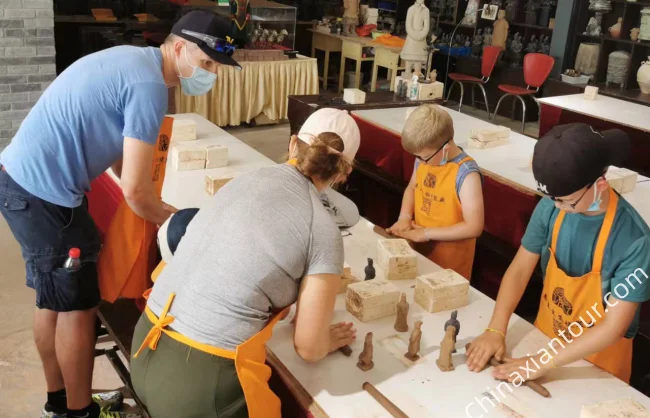
As a Xi’an-based travel operator, China Xian Tour has over 15 years of experience of offering guided tours of Terracotta Army. As a result, beyond exploring the Terracotta Army, we can also arrange you some visits to local workshops where you’ll learn to craft your own terracotta figurines, gaining hands-on insight into the artistry behind these ancient statues. Whether you’re a history buff or a curious traveler, let us craft a personalized journey for you to uncover the secrets of the Qin Dynasty. Contact us today to start planning your adventure!
Apart from the above 10 facts about the Terracotta Warriors, there are more mysteries waiting to discover!
Related reading: 40 Fun Facts About China You Probably Don’t Know