
13 Days Tibet & China Silk Road Group Tour by Train

Tour Overview
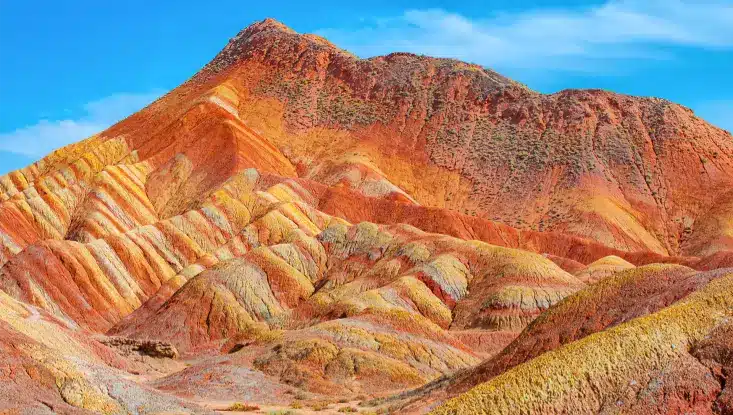
The 13 Days Tibet and China Silk Road Group Tour combines the spiritual essence of Tibet with the historical Hexi Corridor – a vital pathway of the ancient Silk Road. The Silk Road group tour starts in Lhasa and proceeds to Xining, Zhangye, Jiayuguan, and Dunhuang, making it perfect for travelers who love to explore historical sites, religious sites, and cultural heritage sites. Tour highlights include Tibetan monks who engage in debate at their monasteries while visitors explore sacred sites – Yamdrok Lake, Qinghai Lake, Chaka Salt Lake, Zhangye Rainbow Mountains and the famous Mogao Caves together with enjoyable activities in the desert.
The tour creates an experience that showcases Tibetans’ extensive Buddhist practices, their natural beauty, and their historical trade routes through scenic plateau train rides. Each city presents a segment which demonstrates the country’s religious traditions and historical development through its various sacred sites and Lhasa palace temples, peaceful holy lakes, Danxia landforms, Great Wall sections and Dunhuang grotto art.
Travel destinations: Lhasa, Yamdrok Lake, Xining, Zhangye, Jiayuguan, Dunhuang
Suitable for: History Buffs, Culture Explorers, Photography Enthusiasts
Tour type: Group
Highlights of this tour:
- Travel by scenic plateau and high-speed trains, experiencing altitude changes and ever-evolving landscapes.
- Witness lively monk debates, explore the most famous monasteries, and understand the spiritual core of Tibetan Buddhism.
- Admire Yamdrok Lake, Qinghai Lake, and the Mirror-like Chaka Salt Lake. They show the pure beauty and the vast Qinghai–Tibet Plateau.
- Explore Jiayuguan Pass and the western Great Wall hiking route and Dunhuang’s Mogao Caves to discover how ancient Silk Road trade and culture developed and later impacted history.
- The Zhangye Rainbow Mountains and Danxia landforms serve as a photography site because their mineral layers create one of China’s most stunning natural landscapes.
Day-by-day Itinerary
- Day 1: Lhasa Arrival
Welcome to Lhasa, the "City of Sunshine"! It has this title because its annual sunshine duration is over 3000 hours, with mostly sunny weather. At an altitude of 3650 meters, Lhasa is the capital of Xizang and the holy land of Tibetan Buddhism. After arrival, your tour guide will pick you up and send you to your hotel to check in. The remaining time is left for you to adapt to the altitude.
Travel Tips:
- To avoid or alleviate altitude sickness, please avoid strenuous activities such as running and jumping.
- On the day of arrival, do not drink alcohol, drink plenty of water and get sufficient sleep.
- Day 2: Lhasa Temple ExplorationWitness Tibetan Buddhist Learning and Lively Monk Debates
Today you are mainly led to visit some important temples in Lhasa. In the morning, your focus is on the Drepung Temple, which is one of the six major temples of the Yellow Sect. Before the establishment of the People's Republic of China, the number of monks in this temple exceeded 10000, making it the largest Tibetan Buddhist temple in China. Nowadays, it is known as one of the three major monasteries in Lhasa, along with Ganden Monastery and Sera Monastery.
The temple complex extends along the mountain with its white walls that create an illusion of a massive rice pile when viewed from a distance. The Tibetan name of the temple meaning "rice gathering" is a symbol of prosperity. The temple exhibits multiple valuable cultural artifacts which include gilded Buddha statues, thangkas and Buddhist scriptures.

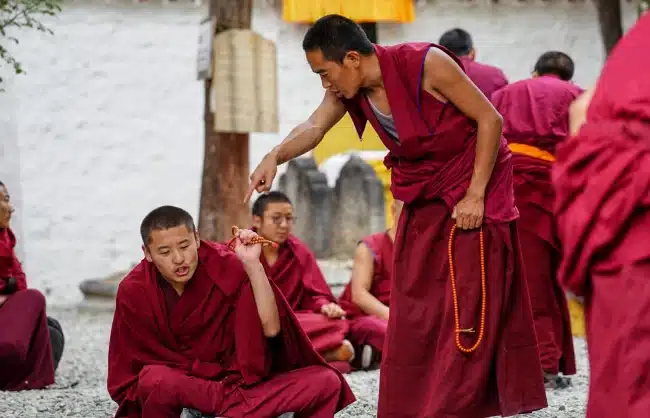
Monks are debating in Sera Monastery In the afternoon, you will visit the Sera Monastery mentioned above. Although it is the latest built among the three major temples, it is definitely worth visiting, especially the debate activities held here, which usually start at 3:00 pm every Monday to Friday. Monks wearing red robes engage in debates through handclaps, body movements, and citing scriptures. Tens of thousands of Vajra Buddhas made locally for Xizang are preserved in the temple. Some were brought from India. The walls of the main hall and scripture halls are adorned with a large number of original colorful murals, which are very spectacular.
After the visit, you will be invited to attend a welcome dinner.
- Day 3: Lhasa HighlightsExperience Lhasa’s Spiritual Heart through Palace, Temple & Street
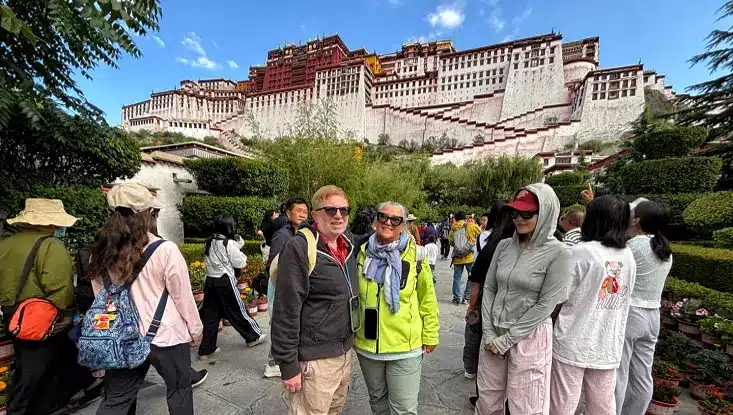
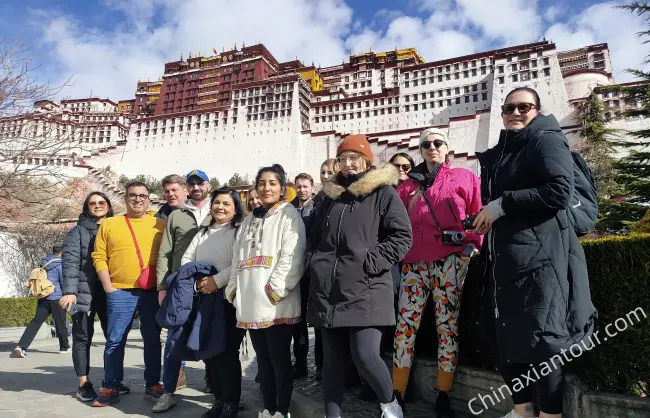
Today's attractions are must sees for anyone traveling to Lhasa. The first stop is the Potala Palace printed on the back of 50 RMB. Built on Hongshan Hill in 631 AD, the main building of the Potala Palace is 117 meters high and has 13 floors. It is a palace style architectural complex that includes palaces, Buddhist halls, administrative offices, and monk houses. You will be led to visit the White House and the Red Palace. The White House was once the administrative office of the local government of Tibet. The Red Palace is a religious activity area with many stupas and Buddhist temples. According to records, one of the stupas used as much as 119000 taels of gold.
Potala Palace Following the tour, engage in traditional folk events by performing Tibetan songs and ethnic dances in the park which is located beneath the palace. The group will travel to Jokhang Temple that Tibetan King Songtsen Gampo established to honor Princess Wencheng's arrival in Tibet after lunch. The Jokhang Temple has existed for more than 1300 years, displaying a combination of Tibetan, Tang, Nepalese and Indian architectural styles, which holds the supreme position in Tibetan Buddhism.
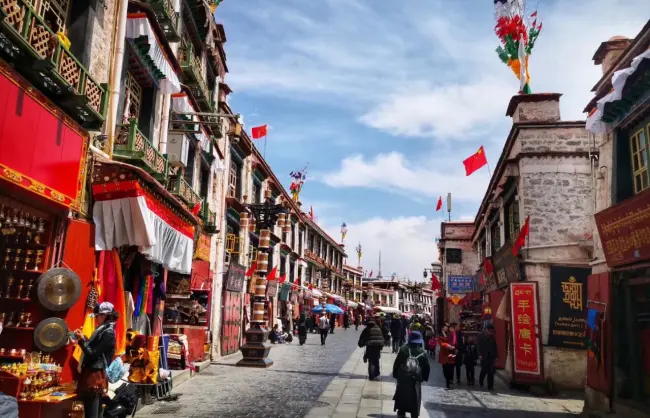
Go to explore Barkhor Street which encircles the temple. The street features a surface made from stones that craftsmen have polished by hand, while traditional Tibetan buildings remain intact beside the street. There exist numerous craft stores which offer bronze Buddha statues, Tibetan knives, Tibetan hats, barley wine, thangka paintings, Tibetan carpets and additional items. The street serves as a walkway which Buddhist practitioners use to complete their ceremonial prayer with their prayer wheels and prayer beads by proceeding with a clockwise movement that includes walking and kowtowing. Finally, your tour guide will take you to taste sweet tea and experience Tibetan social culture.
Barkhor Street - Day 4: Lhasa to Yamdrok LakeAdmire Sacred Yamdrok Lake and the Tranquil Lakeside Monastery Views
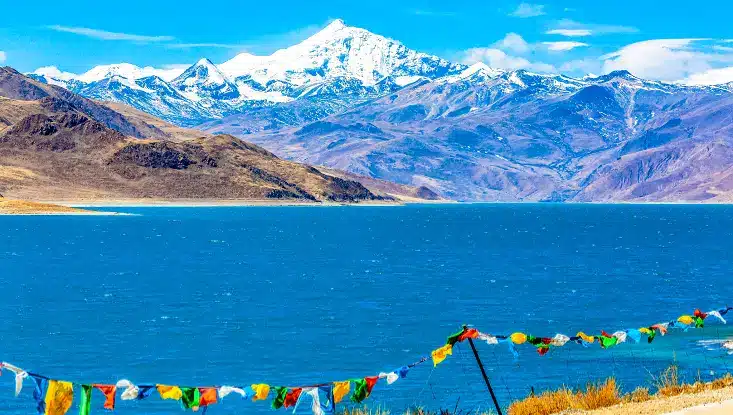
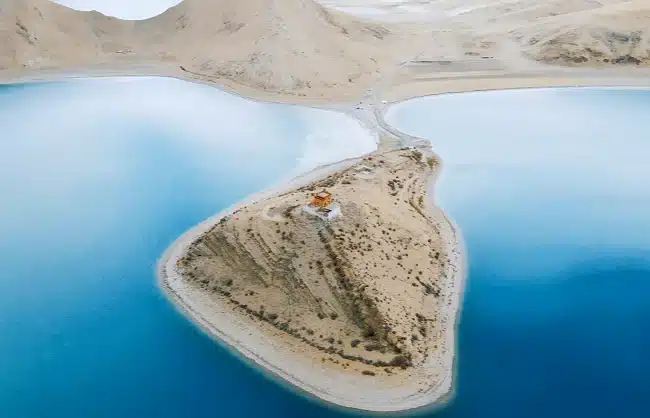
Yamdrok Lake, which means "Jasper Lake" in Tibetan, is one of the three sacred lakes in Tibet. It is also the largest enclosed inland lake in the southern part of the Qinghai Tibet Plateau. After breakfast, drive along G349 to reach the Lurila Observation Deck at an altitude of 4900 meters. This is the best place to overlook Yamdrok Lake, with snow capped mountains and scattered islands in the distance. The blue lake water is like a huge sapphire. Always have your camera ready! Enjoy the beautiful scenery of Yamdrok Lake from different angles along the lake shore.
Under the guidance of a tour guide, visit the Rituo Monastery on the lake. In recent years, it has been referred to by tourists as the 'loneliest temple'. The temple itself is also an observation deck, from where you can see the sparkling blue lake water on three sides in the sunlight. Afterwards, enjoy lunch and coffee by the lake and spend a leisurely time. Last, cross the Gampala Pass and return to Lhasa for a good rest.
Rituo Monastery on Yamdrok Lake - Day 5: Lhasa to Xining by TrainTravel by Scenic Plateau Train, Crossing Snow Mountains, Grasslands
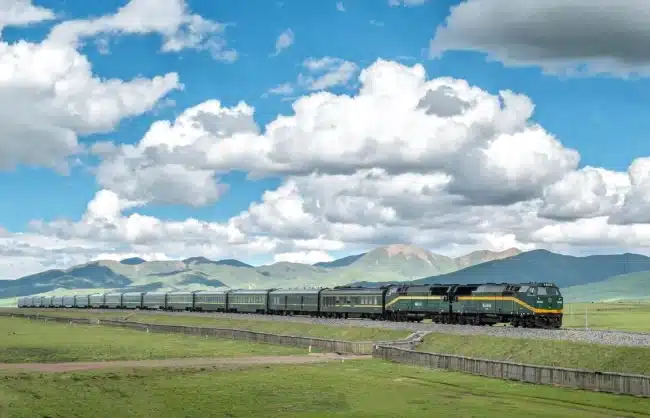
Today, board the train bound for Xining and enjoy one of the most spectacular railway journeys on the Tibetan Plateau. Admire the snow-capped peaks and the majestic Kunlun Mountains stretching across the horizon.
The route continues through the untouched wilderness of the Kekexili Nature Reserve, home to rare wildlife. The landscape gradually opens into the vast Qiangtang Grassland, where endless plains meet the sky. Relax well and take in this amazing panorama. Have a good night on the train. You can buy lunch, dinner, as well as some snacks and drinks on the train.
The scenic views along the train journey from Lhasa to Xining - Day 6: Xining ArrivalDiscover Birthplace of the Gelug School & Tibetan Buddhist Arts
After arriving at Xining Railway Station, the local tour guide will pick you up at the exit and take you to a hotel in the city to check in. After taking a short break, begin your visit in Xining in the afternoon.
Kumbum Monastery serves as the birthplace for the founder who established the Gelug School of Tibetan Buddhism. The building area measures 0.4 square kilometers which extends across Lianhua Mountain slopes. The temple contains three artistic elements, including butter sculpture, murals and barbola (a kind of silk embroidery).
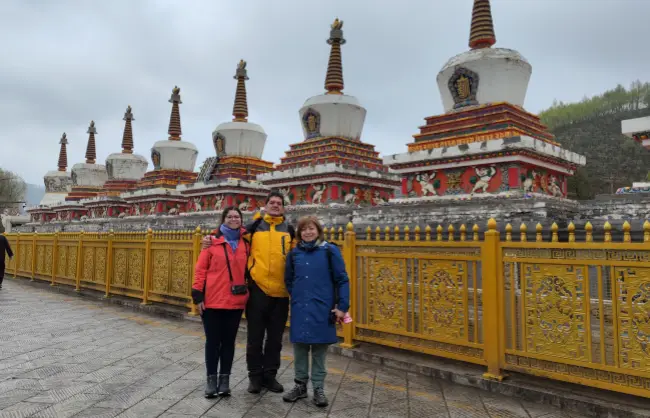
The square in front of the temple contains 8 white Buddhist pagodas which serve as a tribute to the eight accomplishments of Buddha Shakyamuni during his lifetime. The main structure of Kumbum Monastery is the Great Golden Tile Hall. The building has three levels which display numerous valuable historical artifacts that date back to the Ming Dynasty. The Tsongkhapa Memorial Stupa holds the title of most recognized stupa. It stands at a height of 11 meters and its surface displays gilding with gemstones embedded throughout. After the visit, send you back to the hotel to rest.
Travel with CXT to Ta'er Monastery, Xining - Day 7: Xining to Qinghai LakeEnjoy Vast Qinghai Lake scenery with Optional Outdoor Activities
This morning, drive about 3 hours to reach Qinghai Lake, the largest saltwater lake in China and a true highlight of the Qinghai-Tibet Plateau. The landscape opens into a vast view of blue skies, white clouds, and endless green grasslands dotted with roaming sheep and yaks.
The Erlangjian Scenic Area is your primary destination because it contains the most stunning parts of Qinghai Lake. From its well-positioned viewpoints, you can see the crystal-blue waters that extend until they meet the horizon. The optional activities on offer provide you with choices to participate in lake boat cruises and horse riding and lakeside cycling activities.
After enjoying the scenery, continue to Chaka Town for the night.
Travel Tips:
- Sunlight around Qinghai Lake is particularly strong, especially from June to August, so sunglasses, sunscreen, and a hat are highly recommended.
- Although altitude sickness is uncommon, if you are a first-timer to plateau, you should avoid strenuous activity and move at a relaxed pace.
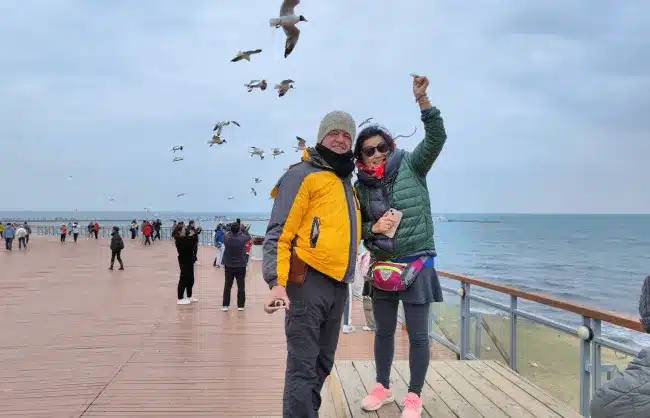
A couple visiting Qinghai Lake - Day 8: Xining to Zhangye by High-speed TrainPhotograph the Mirror of the Sky at Chaka Salt Lake
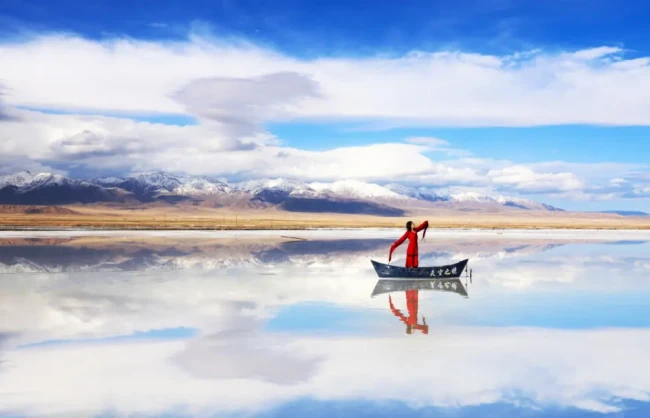
After breakfast, your tour guide will take you to Chaka Salt Lake which people call "Mirror of the Sky in China". The Tibetan Plateau has seen this lake become its most visited tourist site during the last few years. The lake surface transforms into a massive natural mirror because the white salt in the lake slowly dissolves through a thin water layer. The main activity of this place is photography. Your photos will look more attractive when you wear bright-colored clothing which includes red and yellow against the salt surface that contains floating white clouds, blue sky and flying birds.
Travel Tips:
Ultraviolet radiation is strong at Chaka Salt Lake. Sunglasses are essential, and covering your face, neck, and arms is strongly recommended for sun protection.
In the afternoon, drive back to Xining and board an evening high-speed train to Zhangye, about 2.5 hours. Upon arrival at Zhangye Railway Station, your local driver will meet you and transfer you to your hotel.
The Mirror of the Sky - Day 9: Zhangye Canyon HikeVisit Giant Buddha Temple and Hike through Danxia Canyon Landscapes
After breakfast, you and your tour guide will meet in the hotel lobby and then visit the Giant Buddha Temple located in the city center. The biggest attraction of the temple is a clay sculpture reclining Buddha that is 34.5 meters long and 7.5 meters wide on the shoulders. Therefore, the Giant Buddha Temple is also known as the "Reclining Buddha Temple". The Buddha's appearance is peaceful and lifelike. On its back are statues of ten disciples; On the east and west walls, you can see huge murals inspired by the stories of Chinese classical novel - Journey to the West and Creation of the Gods.
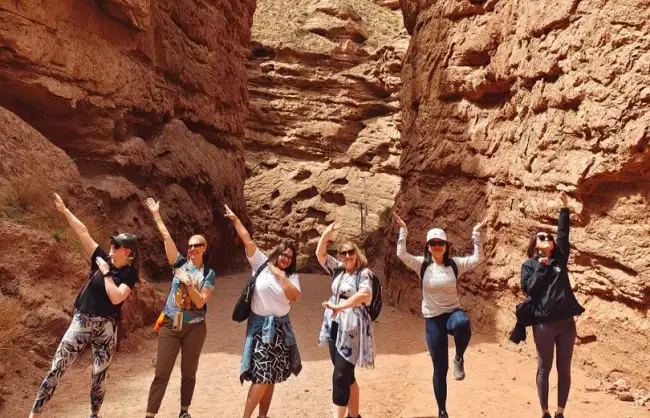
Pingshan Lake Grand Canyon is going to be the next destination after your lunch break. The three major Danxia landscapes of Zhangye include this site which developed through millions of years when crustal uplift combined with wind and water erosion to create its current state. The entire scenic area is divided into two parts: viewing platforms and the canyon itself. The primary platform - No.1 Observation Deck displays rock formations which resemble dragons, generals, turtles and couples. You need to hike for at least 2 hours through the scenic area, so be sure to wear comfortable shoes. (If you have knee issues, please skip this scenic spot.)
Pingshan Lake Grand Canyon - Day 10: Zhangye Rainbow MountainsExplore Sunset Colors at Zhangye Danxia Mountains
Your guide will show you Matisi Temple after breakfast. The site functions as a grotto complex that faces the Qilian Mountains and includes more than just a temple. The majority of existing structures today started as carved creations from 1,600 years ago which have undergone restoration through different time periods. The core attraction of the site is the Thirty-Three Heaven Grottoes. With five levels, 21 caves are carved in the shape of a pagoda on cliffs. If you visit during summer or winter, enjoy spectacular views of the green or snow-capped Qilian Mountains from inside the caves.
The Rainbow Mountain Scenic Area at Zhangye Danxia National Geological Park displays its geological beauty through its colorful natural features. The hills show their painterly appearance because mineral deposits accumulated throughout millions of years. The tour guide will lead you to walk the wooden paths to four different observation platforms that show various views of the Danxia landforms. From Viewing Platform No.1, visitors can see sweeping views of the striped mountains while Viewing Platform No.4 shows its most luminous scenery which becomes especially beautiful during sunset.
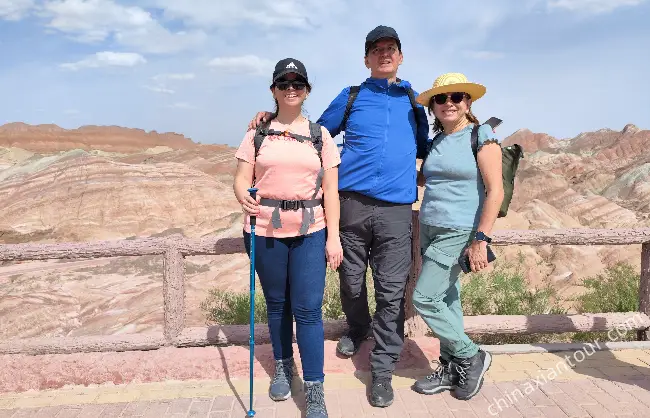
Rainbow Danxian Mountains with our customers Tips:
- The sun can be strong, so bring sunglasses, sunscreen, and a hat.
- Sunset is the best time for photos — around 7–8 pm from June to August and 6–7 pm in December to January.
In the evening, check in at a Mongolian yurt in Kaoshan Tent, near the Rainbow Mountains. Please note that tents have no private bathrooms, only shared bathing and toilet facilities.
- Day 11: Zhangye to Jiayuguan, Drive to DunhuangExplore Jiayuguan Pass and Hike the Great Wall Across Vast Gobi Landscapes
After breakfast, we drive for about 2.5 hours to reach the Jiayuguan Pass, known as the "First and Most Majestic Pass Under Heaven." The city walls on both sides of the pass stretch across the desert and Gobi, connecting to the Overhanging Great Wall of Heishan Mountain in the north and the "NO.1 Beacon" in the south. Historically, it held great significance and was once referred to as the throat of the Hexi Corridor. Jiayuguan Pass served as a crucial gateway along the ancient "Silk Road" and is one of the three most remarkable wonders of the Great Wall of China.
The Overhanging Great Wall which we reach after driving about 20 minutes is a 15-kilometer wall system. The westernmost point of the Great Wall was constructed on a 45-degree steep ridge that resembles an upside down hanging bridge. The restored sections which builders constructed with gravel and loess now include a 750-meter-long ramp and parapet walls and three beacon towers. Those who hike this path will find themselves facing extensive Gobi Desert views extending from the northern slopes of Heishan Mountain to the distant horizon, creating an image of camel caravans that traveled the ancient Silk Road.
After the visit, drive for 4 hours to the hotel in Dunhuang to rest well.
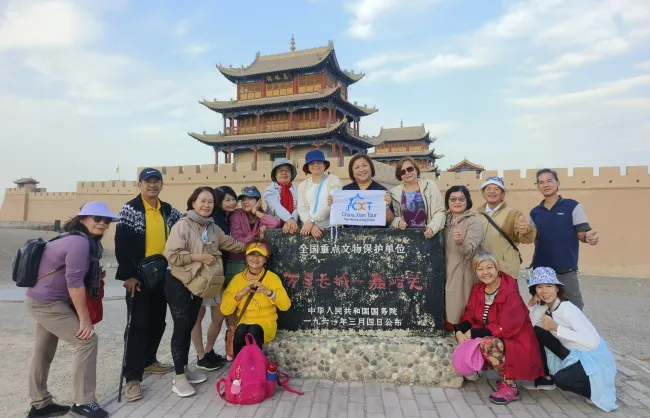
Jiayuguan Pass - Day 12: Essence in DunhuangDiscover Mogao Caves Art, Ride Camels at Mingsha Mountain
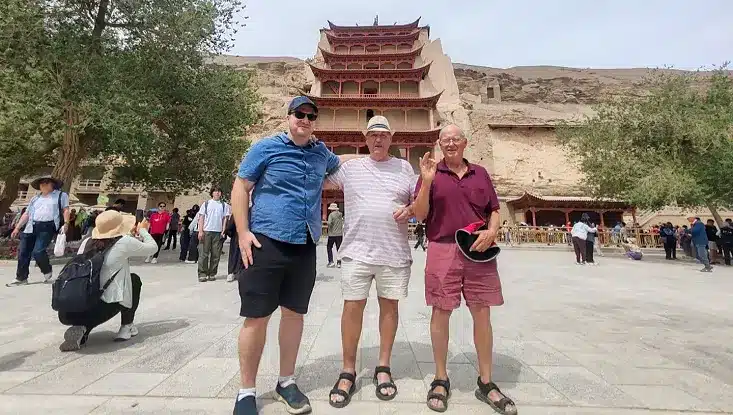
Welcome to the Mogao Caves, a world cultural heritage site! The first construction of this site began during the Pre-Qin Dynasty and multiple construction projects continued for more than two thousand years. The site currently contains 735 caves which hold 45000 square meters of murals and 2415 colored sculptures. The Nine story Building serves as a major landmark at the Mogao Grottoes and it contains the highest seated statue of Maitreya Buddha which reaches 35.5 meter height. The painted sculptures of Cave 45 display perfect craftsmanship; they show detailed facial expressions and their clothing designs move in natural patterns. The cave contains a Bodhisattva statue known as the "Oriental Venus". The Mogao Caves contain their most famous murals displaying bright colors and depicting various themes that include Buddhist scriptures and stories, and social life.
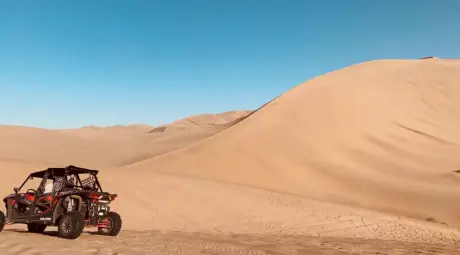
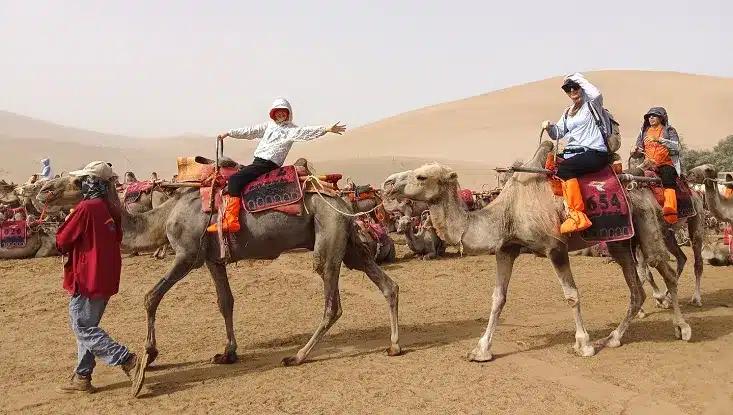
In the afternoon, you will experience the ancient caravan's Silk Road journey in the desert. Located on the edge of the Kumtag Desert, Mingsha Mountain is a typical aeolian sand dune landform. It is said that the "Sand Mountain Age" here has been over 3000 years. Crescent Spring is surrounded by Mingsha Mountain and its shape resembles a crescent moon, hence its name. The site has maintained its water supply for thousands of years which has created a habitat for special fish species and medicinal plants. The local people call them the "Three Treasures" along with the five-colored sand of Mingsha Mountain. The scenic area offers visitors paid desert activities which include camel riding and sand sliding (free) and desert motorcycle rides.
In the evening, head to the Shazhou Night Market to taste various local specialty snacks. Maybe you will even come across some cute souvenirs that you can give to your family and friends.
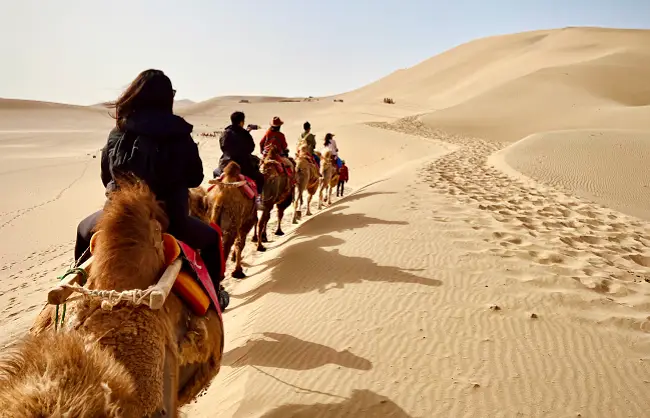
Experience riding a camel - Day 13: Dunhuang Departure
Your 13-day Tibet and Silk Road group tour ends after breakfast. Your driver will pick you up and send you to the airport for departure. Hope you have an unforgettable experience with China Xian Tour. If you want to visit more places in China, please feel free to contact us. We will be very glad to help!
Tour Price Per Person
The price varies depending on the activity, number of people, travel date, and selected hotel. Please contact us for a specific price.
Accommodation For This China Silk Road Tour


For your China private tour, the choice is in your hands: you can select luxury 5-star hotels for unparalleled comfort, cozy 4-star accommodations, or value-for-money 3-star options.
All our partner hotels are handpicked for their prime locations, conveniently situated near bustling commercial areas. Every room is equipped with standard amenities like air conditioning, hot water, 24-hour showers, reliable Wi-Fi, and windows for natural light.
In some hotels, there are English-speaking staff who are committed to providing attentive service. Should you have any special requests, feel free to ask - they are always ready to assist.


