

The Mid-Autumn Festival or the Moon Festival is an important traditional festival in China. On August 15th of the lunar calendar, usually late September or early October, people get together with their family to celebrate the fall and harvest. The moon on this day is the largest and brightest, so the history and celebration of Mid-Autumn Festival put a lot of emphasis on moon worship.
And what are some traditional foods that are associated with the celebration and the fall? This article will focus on the top 10 traditional Chinese Mid-Autumn Festival foods in this time of reunion, happiness, and gratitude.
Content Preview
- 1. Mooncakes: Classic Festival Pastry
- 2. Chinese Hairy Crabs: Seasonal Favorite
- 3. Taro: Popular Root Vegetable
- 4. River Snails: Unexpected Delicacies
- 5. Lotus Roots: Tasty Jiangnan Snack
- 6. Osmanthus Wine: the Sweetness of Life
- 7. Ducks: Symbols of Family Reunion
- 8. Pomegranates: Fertility and Prosperity
- 9. Ciba: Glutinous Rice Cakes
- 10. Pomelos: Fruit of Blessing
- 11. Drinking Tea under the Moonlight
- 12. The Taste of Mid-Autumn Festival – Persimmons
- Tips for Eating Mid-Autumn Festival Foods
- Historical Origins of Mid-Autumn Festival Food Traditions
- Modern Twists of the Traditional Food
- FAQs about Mid-Autumn Festival Foods
- Embark on a China Culture Tour with China Xian Tour
1. Mooncakes: Classic Festival Pastry
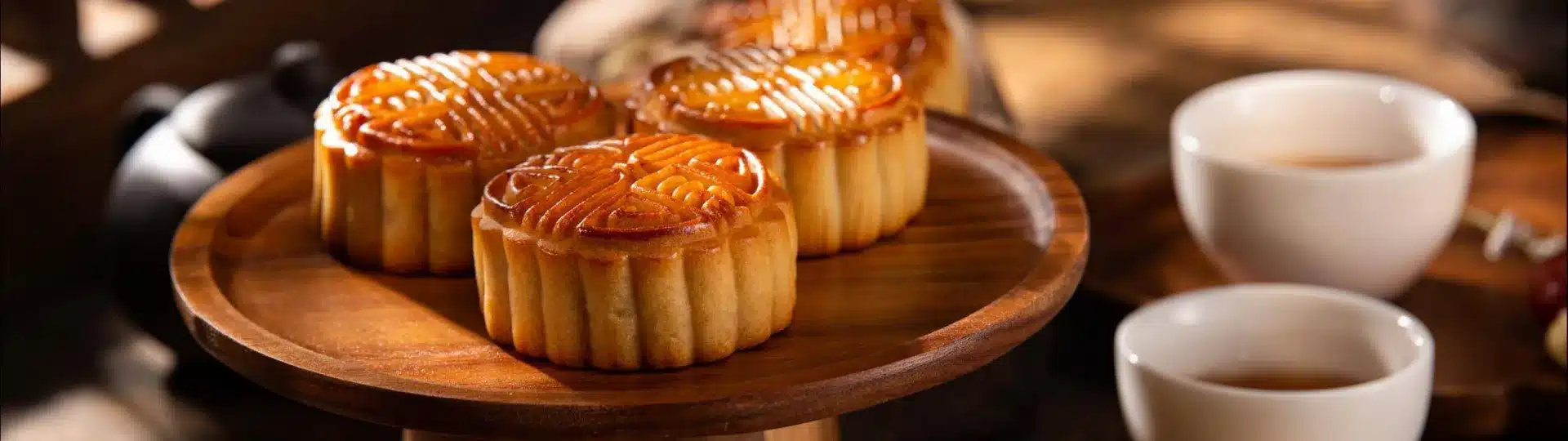
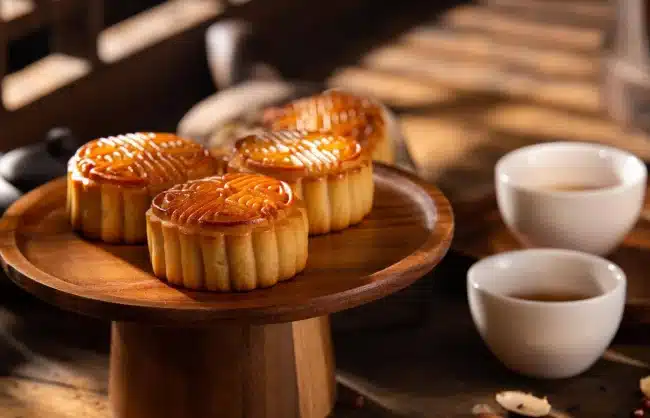
Mooncakes are the most representative Mid-Autumn Festival food. They were originally used as a tribute to the moon god and later gradually became a symbolic food for Mid-Autumn Festival reunion. They are round baked pastries with different flavored fillings inside, usually sweet.
The shape of moon cake is to resemble the shape of the full moon. And in Chinese, the word for fullness and roundness can also be used to describe a complete and happy family reunion. There are many kinds of mooncakes, such as Cantonese-style, Su-style, Chao-style (of Chaozhou, Guangdong), Jing-style (of Beijing), and so on, each with regional specialty and characteristic.
Cantonese-style mooncakes are specialties of Guangdong Province and the most popular style of mooncakes in China. With thin skin and thick filling, they are soft and heavy. They come with a wide range of fillings. The most common ones are red bean paste, lotus seed paste, salted egg yolk, five kernels and so on.
The red bean paste is sweet with the fine texture of beans. The salted egg yolks bring hints of savory flavors to the subtly sweet lotus seed. And the five kernels have the texture and scent of nuts.
Su-style mooncakes are traditional snacks of Suzhou, Jiangsu Province and well-loved Mid-Autumn Festival food of people in Yangtze Delta region around Shanghai.
They are best known for their savory mooncakes with pork meat. The skin of Su-style mooncakes is crispy and flaky. They are the best when freshly baked with delicious meat inside. Another popular flavor is a salt and pepper filling with melon seeds. Again, they are best when they’re fresh and warm out of the oven.
Related reading: How to Eat Mooncakes During the Mid-autumn Festival Properly
2. Chinese Hairy Crabs: Seasonal Favorite
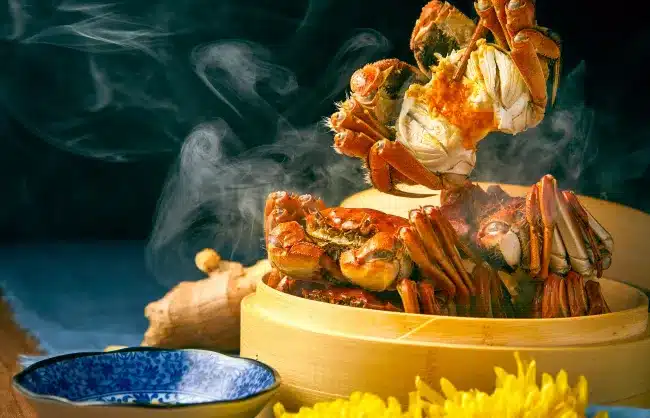
Chinese hairy crabs, or Chinese mitten crabs, are a favorite Mid-Autumn Festival food for many Chinese people. They are the fattest during this time of the year. In as early as Ming Dynasty, they have been the highlight of the festival banquet.
The traditional method of cooking is to simply steam them, which maintains the original flavors of the crabs. They are steamed to a bright orange color. The white crab meat is tender and slightly sweet, is best complemented with a ginger vinegar dip. If you travel to China around Mid-Autumn Festival, you have to try the hairy crabs.
In Chinese, “Crab” and “thank” are homophones. For Mid-Autumn Festival, eating hairy crabs is a way of expressing thanks to your family. People also give them as gifts to show their gratitude.
3. Taro: Popular Root Vegetable
Taro is another Chinese Mid-Autumn Festival food especially in Jiangsu, Zhejiang, and Guangdong. Eating taro is said to disperse evil spirits and misfortunes. “Taro,” or “Yu Tou” in Chinese is a homophone of “surplus.” Having taro is to hope that life always has more to offer tomorrow. Resources will be abundant.
Taro can be boiled, steamed, baked, and done in other ways. Cooked taro is soft. You can dip it in sugar or make into dishes like sweetened taro, taro soup, or soy sauce braised taro.
4. River Snails: Unexpected Delicacies
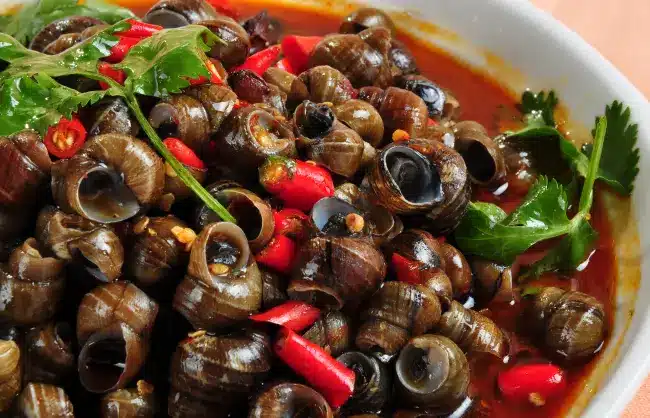
River snails are a popular Chinese food for Mid-Autumn Festival in Guangdong and Yunnan. Around the time of the festival is the best time for river snails. They are stir-fried with chili pepper, ginger, garlic, and other spices. They smell amazing, and when you eat them, you pick out the meat with a toothpick. You’ll find them spicy, delicious, and chewy. It’s definitely an experience to be had on your China tour in autumn.
5. Lotus Roots: Tasty Jiangnan Snack
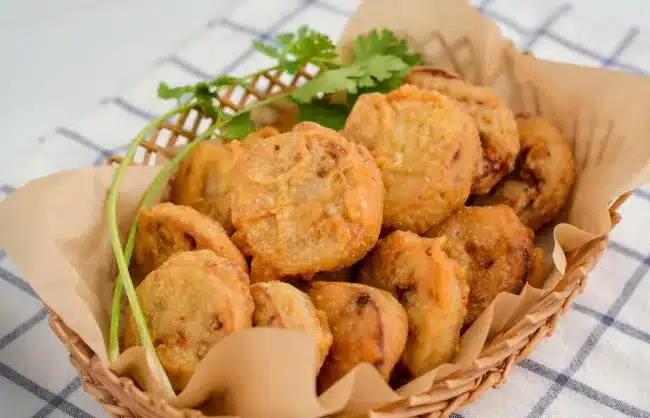
Autumn is the season when lotus roots come on the market. It’s a tradition to eat them in Jiangsu and Zhejiang for the festival, especially “lotus box.” People buy fresh lotus roots, cut them into round slices, put a filling, usually made of meat, clams and other ingredients, between two slices to make a sandwich. They’re fried till golden brown on both sides. They’re crispy on the outside, soft and juicy on the inside.
The shape of “Lotus Box,” similar to mooncakes, symbolizes the happiness of family reunion. There’s a phrase in Chinese, “even when the lotus root is broken apart, its fiber is still attached,” meaning despite the distance between, families are still connected by their thoughts for each other. Don’t miss this traditional snack on your China culture tour.
6. Osmanthus Wine: the Sweetness of Life
Osmanthus wine is the perfect complement to the Mid-Autumn Festival foods and the full moon. Fall is the season of osmanthus. The golden flowers bloom in the trees, sending sweet fragrance into the cool winds. Under the full moon, the tiny blossoms fall onto the ground like snow.
Drinking osmanthus wine is a tradition with long history in China. In Han and Tang Dynasties, people celebrated Mid-Autumn Festival by mounting pavilions to appreciate the moon and drinking to it. Osmanthus wine was also served at banquets to guests or friends. This tradition carried onto Ming and Qing Dynasties and even today.
Osmanthus wine is brewed with osmanthus and aged rice wine. The drink is of a light golden color with the fragrance of the flower. It is sweet and not strong, symbolizing prosperity, auspiciousness, and the sweetness in life. Embark on an ancient China city tour to trace the history behind the traditions.
7. Ducks: Symbols of Family Reunion
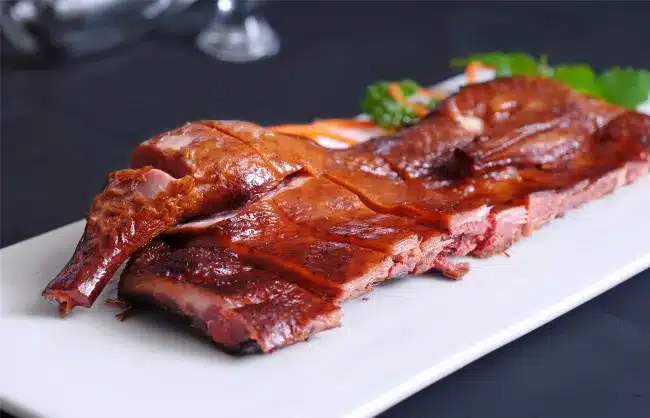
Another popular food for Mid-Autumn Festival is ducks. Fall is the best season to have ducks, and different regions have different practices. Shanghai has Eight Treasure (Babao) duck, crispy duck, and soy-sauce duck. There’s also tea-smoked duck from Sichuan, osmanthus duck from Nanjing, Jiangsu. Ducks became a common Mid-Autumn Festival food because of their health benefits and nutrition.
Recommended China Food Tours:
- Shanghai Night Food Tour with Huangpu River Cruise
- 3 Days Chengdu Food Tour with Cooking Class Experience
- 5 Days Xian Food Tour
- 13 Days China Food Tour: Beijing Xian Chengdu Guilin Hong Kong
8. Pomegranates: Fertility and Prosperity
The most important fruit among Chinese Mid-Autum Festival foods is pomegranates. This is the time of year when they ripen. They should be bright red or pink, and often cracked. The bright and plump seeds inside are like rubies. So pomegranates are regarded as a symbol for fertility in Chinese culture. They are an essential on the Mid-Autumn Festival dinner table.
9. Ciba: Glutinous Rice Cakes
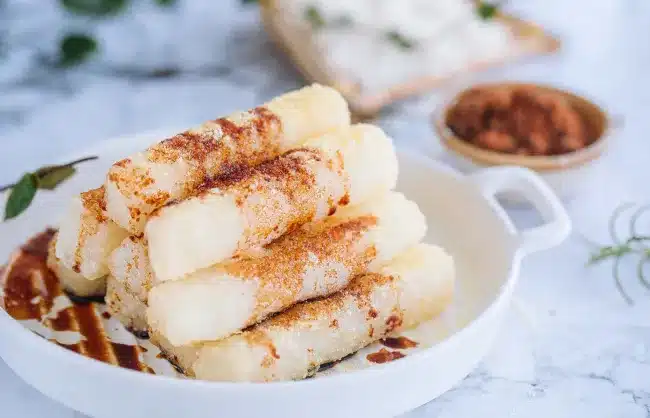
Of course there’re desserts in traditional Chinese Mid-Autum Festival foods. Cibas are glutinous rice cakes made into different shapes, usually with brown sugar. They represent the sweetness and happiness of the festival. In some regions, people add osmanthus or dip the cibas in sugar.
10. Pomelos: Fruit of Blessing
Traditional Mid-Autumn Festival food also includes pomelos, a sour, slightly bitter, and sweet fruit rich in nutritional value. It contains a large number of nutrients and vitamins that our body needs. Its flavors also complement with other Mid-Autumn Festival foods well, which tend to be sweet and greasy. They are golden, bright yellow on the outside, and pink on the inside.
The round shape of pomelos, like mooncakes, also symbolizes reunion. And in Chinese, “pomelo” and “bless” are homophones. So it’s also the fruit of blessing and protection in Chinese culture.
11. Drinking Tea under the Moonlight
The Mid-Autumn Festival and tea have a long-standing connection in China. Since the Han Dynasty, boiling tea under the moonlight and engaging in poetry recitation and dialogue have been the refined customs of scholars and poets.
There are so many beautiful poems and songs about tasting tea and enjoying the moonlight.
In the Tang Dynasty, people brewed tea with whole tea leaves and enjoyed the moon, symbolizing the family reunion.
Tea is a must-have drink for the Mid-Autumn Festival. So, what kind of tea is best to drink at this time? Pu’er ripe tea can alleviate the discomfort in the stomach and intestines after eating mooncakes. It can also effectively aid digestion and lower cholesterol. In Yunnan, there is even mooncake tea, which is made from Pu’er tea and goes through 12 processing steps to form round tea cakes with petal-like textures. Green tea and small green tangerines (a combination of dried tangerine peel and ripe tea) are also excellent choices.
12. The Taste of Mid-Autumn Festival – Persimmons
Are there other fruits to eat on the Mid-Autumn Festival? Here comes persimmon. It is large and round, in the shape of an amulet – very auspicious for the Chinese people. Also, “persimmon” sounds similar to “event” in Chinese, symbolizing “everything goes well”. The bright red color of persimmons, like a bunch of small lanterns, creates a festive atmosphere. No wonder, placing persimmons at home or eating them has become a custom.
Tips for Eating Mid-Autumn Festival Foods
- You may know that mooncakes are not really a healthy food – they are high in calories, sugar, and fat. So, better eat less than one each day. Chinese tea is a perfect match for mooncakes. It can help reduce greasiness and alleviate stomach burden.
- For foodies planning to eat crabs during the Mid-Autumn Festival, do not eat them together with persimmons, pears, tea water, peanuts, etc.
- It is a good idea to combine various Mid-Autumn Festival delicacies in a reasonable way, such as mooncakes with chrysanthemum tea, wine with crabs. End with a Pomelo.
Historical Origins of Mid-Autumn Festival Food Traditions
The stories of Mid-Autumn Festival food has been told by generations after generations for over through thousands of years. In ancient times, people would provide simple offerings (e.g., fresh fruits, grains, and wine) to the moon as a gesture of appreciating and celebrating a good autumn harvest. Over time, these offerings evolved into some more symbolic foods.
Mooncake, for example, was originally served as sacrificial cakes used in moon worship ceremonies. And after years, it had become the iconic pastry of reunion which every people can share on this special day. Besides, Chinese people were also used to brew sweet osmanthus wine each autumn, as they believe this can help them capture the fragrance and memory of the season.
These traditions spread across regions and time, making all those local flavors and customs the bases of the rich variety of Mid-Autumn Festival foods enjoyed today.
Modern Twists of the Traditional Food
Today, Mid-Autumn Festival foods have also responded the call of globalization, taking on more and more creative and modern twists. To meet younger generations’ expectation of mooncakes with modern flavors, ice cream, chocolate, matcha, and even truffle have now all been used as fillings. And some bakeries also develop their own recipe to make low-sugar or vegan versions for health-conscious eaters.
Traditional savory dishes also adapt to modern dining. For example, to make the hairy crabs more appealing on the dining-table, instead of just serving the steaming version, restaurants might also prepare them with spicy Sichuan-style flavors. And even osmanthus wine are now wildely appears in cocktails and cakes.
FAQs about Mid-Autumn Festival Foods
What seasonal ingredients are commonly used in Mid-Autumn Festival dishes?
Seasonal ingredients like taro or osmanthus flowers are widely used. They will be at their best in autumn.
Why are mooncakes considered the symbol of the festival?
Mooncakes are all made in the round shape to mimic the image of full moon, the most iconic symbol of completeness and reunion in Chinese culture. So that sharing mooncakes with family reinforces the festival’s core values of sharing harmony and togetherness with your loved ones.
How long do mooncakes and other festival foods typically stay fresh?
Baked mooncakes can last 1–2 weeks at room temperature, while fresh foods like hairy crabs or lotus root dishes should be eaten within a day. Snow skin mooncakes and ciba are best refrigerated and consumed within 5–7 days.
What is the story behind eating ducks or river snails for the festival?
Ducks are eaten at Mid-Autumn both for their peak seasonal flavor and because a folk tale links “eating duck” with victory over the Yuan rulers. In Guangdong, river snails are enjoyed in autumn when they’re fattest, and tradition says they help brighten the eyes.
Are there any modern or non-traditional foods associated with the Mid-Autumn Festival?
Yes. Today, you’ll find ice cream mooncakes, fruit jellies, and even Western-style cakes shaped like the moon.
Embark on a China Culture Tour with China Xian Tour
Traditional foods are a good starting point for you to dive into China’s rich cultural and historical heritage. To explore more of Chinese culture and traditional festivals like Mid-Autumn Day, we strongly recommend you to embark on a guided journey with China Xian Tour. With the help of our local travel experts, you’ll get a perfect journey which is made completely based on your own preference, and we’ll also provide you with private transfers and professional guides. From start to finish, we’ll take care of all the preparation for you so that you can fully enjoy the unforgettable festive vibes.
Read More about Mid-Autumn Festival & Visiting China in the Fall: