





The Four Great Inventions of China — papermaking, printing, gunpowder, and the compass — are among the most influential technological innovations in world history. Developed in ancient China, these breakthroughs transformed communication, navigation, warfare, and the spread of knowledge across civilizations.
These innovations emerged from practical needs such as recording knowledge or navigating long distances. Eventually, they truly made it easier for people to record and share knowledge, accelerate the spread of education, revolutionize navigation, transform warfare, and reshape political power structures.
After traveled to different regions through the Silk Road, the Four Great Inventions had also left their traces in the development of global civilization. Moreover, although they were created thousands of years ago, people today still benefit from their lasting impact.
Content Preview
- What Are the Four Great Inventions of Ancient China?
- Where to Explore the History of the Four Great Inventions in China
- Interesting Facts About the Four Great Inventions
- How the Four Great Inventions Spread Around the World
- Other Important Ancient Chinese Inventions
- China’s “New Four Great Inventions”
- Travel through the Legacy of China’s Four Great Inventions with China Xian Tour
What Are the Four Great Inventions of Ancient China?
The Four Great Inventions of ancient China are papermaking, printing, the compass, and gunpowder. Before we go deeper into each one of them, we need to first figure out one thing: why these four inventions eventually became the “Four Great Inventions?”
The answer lies in their essential impacts: they allowed ancient societies to progress more rapidly toward the development of the modern world. They were the fundamental tools of connecting people and nations, and played a decisive and foundational role in the spread of knowledge or the integration of societies.
- Compass– Originating over 2,000 years ago during the Warring States period (475–221 BCE). The earliest compass appeared as the “sinan.”
- Papermaking – Around 1,900 years ago(105 CE), the court official Cai Lun of the Eastern Han Dynasty improved the original papermaking process by using plant fibers such as bark, hemp, and old cloth.
- Printing – Woodblock printing was developed about 1,300–1,400 years ago during the Tang Dynasty (7th century).
- Gunpowder – Discovered roughly 1,100–1,200 years agoby Taoist alchemists in the Tang Dynasty (9th century).
Papermaking – The Invention That Transformed Knowledge Sharing
The Invention of Paper in the Han Dynasty
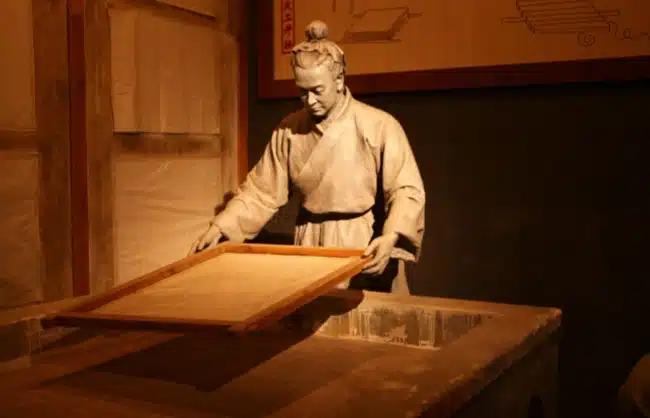
The first thing we’re going to talk about is something that everyone uses in their daily lives: paper. Archaeological discoveries show that primitive paper already existed during the Western Han Dynasty. However, this early version was rough and hard to produce.
Around 105 CE (Eastern Han Dynasty), the court official Cai Lun improved the papermaking process by using more common materials and easier methods. He was reportedly inspired by observing how wasps make their nests.
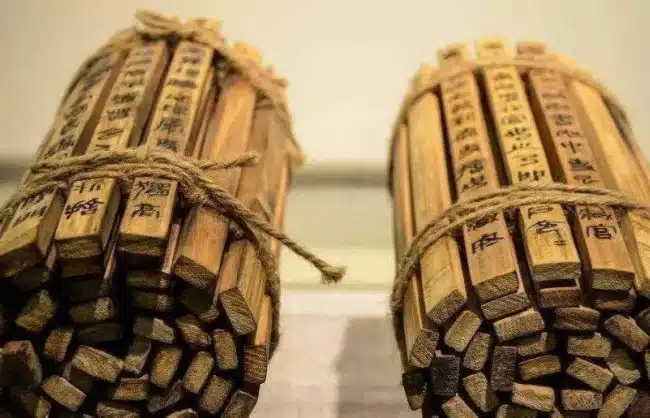
Such an invention really changed people’s lives. In the past, people could only write on materials such as bamboo slips, silk, or bones, and none of them was practical for large production. This papermaking technology later played a crucial role in the spread of knowledge.
The Ancient Chinese Papermaking Process
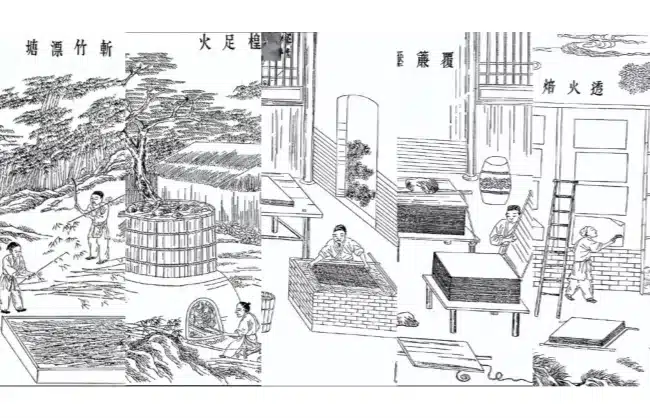
- Step 1 – Prepare the Raw Materials
Tree bark, hemp, old rags, and fishing nets.
- Step 2 – Soaking and Boiling
Soak the material in water and boil it. Then separate the fibers.
- Step 3 – Beating the Fibers into Pulp
Beat the softened fibers and mix them with water to create a fine pulp.
- Step 4 – Forming the Paper Sheet
Dip a flat screen or mold into the pulp to lift a thin layer of fibers.
- Step 5 – Draining and Pressing
Excess water drained away. Press the sheet to remove remaining moisture.
- Step 6 – Drying the Paper
Dry the sheet, forming a smooth and lightweight surface suitable for writing.
How Papermaking Spread and Changed the World
Papermaking gradually spread beyond China through trade and cultural exchange. It reached Korea and Japan first by the 7th century. Later, it spread to the Middle East and Europe through the Silk Road. The availability of paper-made books and written records was more common everywhere. Cultures were able to document their histories and knowledge more effectively.
Printing – From Woodblock Printing to Movable Type
Woodblock Printing in the Tang Dynasty
Early forms of printing in China can be traced back to the Eastern Han Dynasty, where a technique known as rubbing (ink rubbing or stone rubbing) was developed. Later in the Tang Dynasty, Buddhism reached its peak in China, and the need to reproduce Buddhist scriptures rose sharply. As a result, people faced a need to improve the printing technology. Then they invented woodblock printing.
The process was easy and clear. A craftsman would first carve entire pages of text, including their image, onto wooden blocks, then apply ink to the surface, and finally press paper onto the block. With this new invention, large quantities of religious texts were reproduced and smoothly distributed to the temples and believers. And this is also why printing was recognized as a major force in the fast and widespread spread of Buddhist teachings across different regions in ancient China. A famous example is the Diamond Sutra printed in 868 CE, a book of Buddhist philosophy from India. It is widely considered to be the earliest dated printed book in the world.
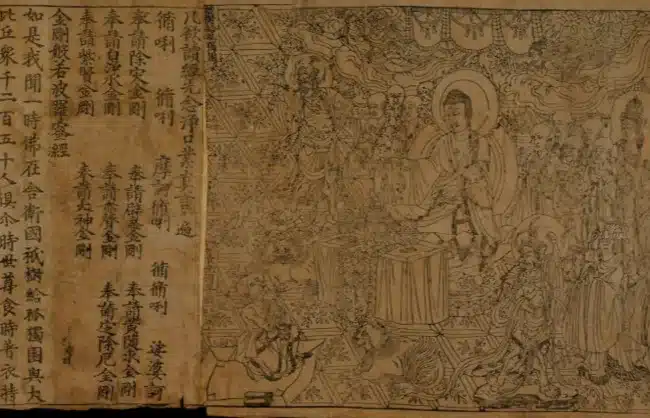
And except for the religious texts, woodblock printing also helped make calendars, government documents, and early books. Reproducing and sharing written information became way easier than before.
Bi Sheng and Movable Type Printing in the Song Dynasty
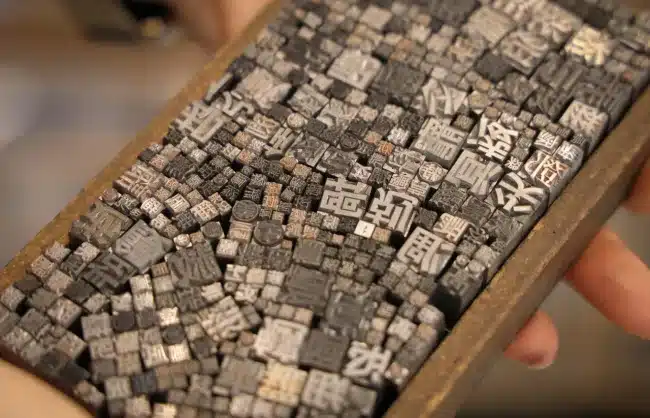
Chinese people had never stopped improving printing. During the Song Dynasty, a tradesman called Bi Sheng developed an innovative printing method, which was the famous movable type printing. It was more efficient and productive than its predecessor.
Instead of carving a full page onto a wooden block, Bi Sheng tried to create individual characters made from clay. These characters could be arranged freely on a frame to form a page and then reused for different pages after printing. The printing process thus became more flexible and it did not need people to carve new blocks for every new page.
This method didn’t immediately replace woodblock printing, and the old method still remained widely used for a long while. However, the movable type was a really impressive technological breakthrough. It also showed ancient Chinese people’s determination to never stop imagining and making a better life.
How Printing Technology Expanded Knowledge and Education
The development of printing technology made it easier for people to produce books and written materials. A large quantity of texts could be printed in a rather short time at a much lower cost.
As a result, anything that could be printed on paper (literature, historical records, and scientific works) spread widely across regions and other countries. Printing made classical texts easier to reproduce and access, allowing more people to study and receive education.
Over time, the technology spread beyond East Asia and helped expand the global circulation of knowledge. This technology propelled the European Renaissance and the Religious Revolution later in time.
Gunpowder in Ancient China – The Discovery That Changed Warfare
The Accidental Discovery of Gunpowder by Tang Dynasty Alchemists
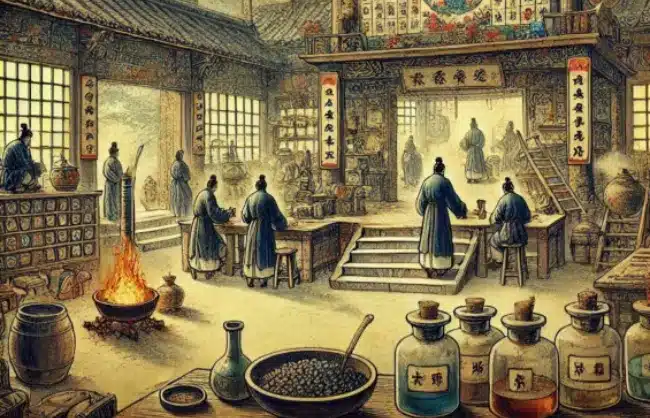
Compared with the two technologies mentioned above, gunpowder’s innovation was a more accidental case. It was discovered in the Tang Dynasty by Taoist alchemists who were experimenting to search for an elixir of immortality.
In their experiments, they used chemical materials such as saltpeter, sulfur, and charcoal, and then they mixed these things together. However, they didn’t get their life-giving medicine in the end, but a highly flammable and explosive substance. This accidental discovery was gunpowder, one of the most important technological breakthroughs in ancient China.
Early Uses of Gunpowder in Fireworks and Military Technology
In the beginning, gunpowder was only used for fireworks and ceremonial displays, especially during festivals like the Chinese New Year. In the late Tang Dynasty, its potential in warfare had been discovered. And by the Song Dynasty, people formed a better mastery of gunpowder. It made weapons such as fire arrows, explosive bombs, and primitive rockets more powerful than ever.
The Global Impact of Gunpowder on Warfare
Gunpowder technology gradually spread beyond China through trade and cultural exchanges along the Silk Road. By the 13th century, knowledge of gunpowder had traveled to the Middle East and Europe. Over time, gunpowder played a crucial role in shaping global military history and technological development.
The Compass – The South-Pointing Spoon
The South-Pointing Lodestone Spoon
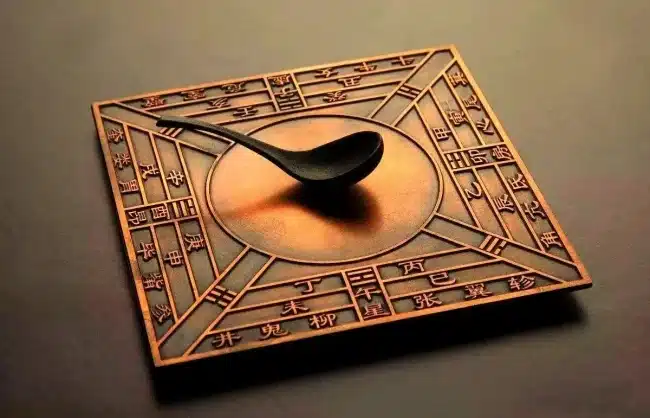
The earliest form of the compass appeared more than 2,000 years ago, and that was during the Warring States period. And in the beginning, it was known as sinan (south-pointing spoon), a spoon-shaped device made from naturally magnetized lodestone.
The “spoon” was placed on a smooth plate with directions marked on it, and the spoon’s handle would naturally point south due to magnetic properties. Although it was not yet used for navigation, it helped people determine direction and was sometimes applied in geomancy and early geographic orientation.
Development of the Magnetic Compass in the Song Dynasty
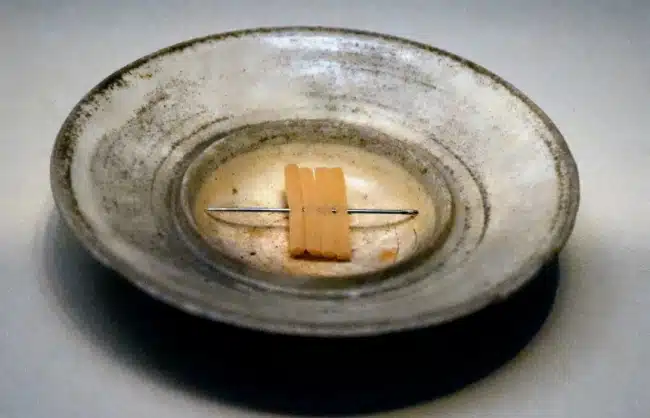
Navigation was never an easy thing in the medieval world. While maps were available, they only showed a small part of the world, and people could only rely on stars or other natural landmarks to confirm their locations. The invention of the compass changed this pattern. Over time, Chinese scholars improved direction-finding technology by developing the magnetic needle compass. By the Song Dynasty, craftsmen figured out how to magnetize iron needles and make them indicate direction more accurately: place them on floating objects or pivots.
In 1088, the famous scholar and court official Shen Kuo recorded the use of the magnetic needle compass in his book Dream Pool Essays. This improvement made the compass practical for navigation at sea. Sailors could determine direction even when the sun or stars were not visible. The long-distance voyages thus became more reliable and safer.
The Compass and the Age of Global Exploration
The compass reached other parts of the world when ancient China began to actively engage in cultural and economic exchanges with more and more regions. By the 12th and 13th centuries, people in the Middle East and Europe started to use this type of magnetic compass. Its use allowed sailors to travel farther across open oceans without relying solely on coastal landmarks. The compass became a crucial tool during the Age of Exploration, contributed so much in the international navigation and maritime commerce. And it’s such an impressive thing that the world could get connected by this little compass.
Where to Explore the History of the Four Great Inventions in China
The first destination we would suggest is the Song Dynasty Science and Technology Exhibition at the Kaifeng Museum. It displays major technological achievements of the Song Dynasty and their influence on world civilization. A key section focuses on three of the Four Great Inventions: the compass, movable type printing, and the application of gunpowder.
Recommended tour

Journey through China's ancient heartland visiting UNESCO sites including Yin Ruins, Shaolin Temple, and Longmen Grottoes across Zhengzhou, Kaifeng, Dengfeng and Luoyang.
To see more of the Four Great Inventions, consider going to attractions like the China Printing Museum and Forbidden City in Beijing, the Oriental Metropolitan Museum in Nanjing, or the Sanxingdui Ruin Site in Sichuan, near Chengdu. These cities are ideal destinations for a China history tour.
Recommended tours:
2 Days Nanjing Culture & Heritage Tour
Interesting Facts About the Four Great Inventions
After grabbing a brief history of the Four Great Inventions, we can now have a look at some fascinating facts about them:
Early papermaking often used some quite surprising materials such as old cloth, tree bark, hemp, and even worn fishing nets, and all of them were easy to find in everyday life.
Printing technology in China appeared centuries before similar technologies developed in Europe. Buddhist texts were already reproduced by woodblock printing in the Tang Dynasty.
The discovery of gunpowder was actually accidental. Ancient Chinese alchemists had never stopped searching for an elixir of immortality. During another process of refining pills, a Tang Dynasty alchemist made a special finding. It didn’t give him the secret of how to “live forever”, but it gave people the opportunity to see fireworks and later changed the global military history.
Meanwhile, the earliest compass looked very different from modern ones. They looked exactly like some spoons, and it’s amazing to see how the “daily utensil” changes the world.
How the Four Great Inventions Spread Around the World
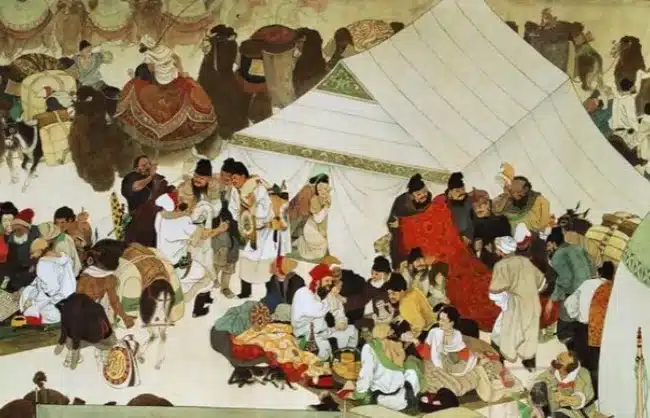
The Four Great Inventions, paper, printing, gunpowder, and the compass, originated in China but have profoundly shaped the whole human civilization. And their transmission to the West was largely based on the existence of the Silk Road and maritime trade. For a long time, a mix of commerce, cultural exchange, and military conflict was happening on the roads.
It was after Cai Lun’s improvements in the Eastern Han that paper first got widely produced. It reached Korea and Japan early, and the westward spread accelerated after the Battle of Talas (751). After the war, some Chinese paper craftsmen were captured by Arab forces. Then they established paper mills in Samarkand and later Baghdad, from where paper gradually reached Spain, Italy, and the rest of Europe, enabling the eventual European Renaissance.
Printing still first spread to Korea and Japan. Through Mongol-era networks, Chinese printing then reached the Middle East and Russia. This spread influenced early European printing before Gutenberg developed his movable type in the 15th century.
Gunpowder’s military potential spread west via Arab intermediaries and Mongol conquests, and it eventually reached Europe by the 14th century. Gunpowder transformed warfare and enabled new armies and imperial expansion.
Finally, the compass was adopted by Arab and Persian sailors through the Indian Ocean trade. By the 12th century, European sailors used it extensively, laying the groundwork for the Age of Exploration.
Together, the Four Great Inventions not only advanced Chinese society but also reshaped Europe, the Islamic world, and eventually the entire globe. They left their significant traces in almost every aspect of people’s lives from the past to the present.

Recommended Silk Road Tours:
11 Days Xinjiang Silk Road Tour from Kashgar to Xi’an
7 Days Silk Road Tour by Train: Xian Zhangye Jiayuguan Dunhuang
15 Days In-depth Silk Road Tour from Xian to Xinjiang
8 Days Classic Silk Road Tour from Xian to Dunhuang by Flight
Other Important Ancient Chinese Inventions
Except for the Four Great Inventions, there were still a lot of splendid technologies and products invented in ancient China. And many of them have even left a great influence on the whole world’s civilization. Among them, silk, porcelain, and the Water-Powered Astronomical Clock Tower were particularly important.
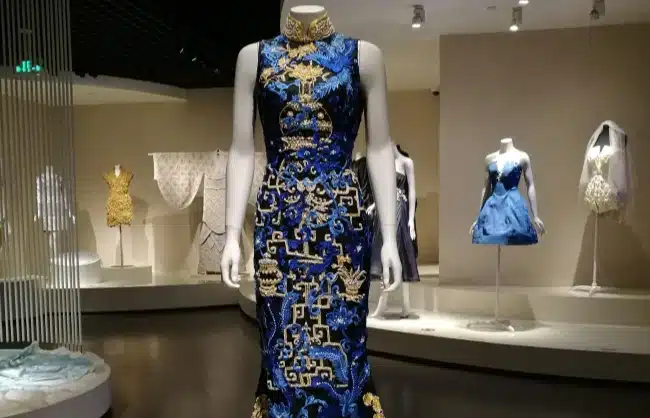
When talking about an iconic product of China, what will you first think of? To many people, that’ll silk. It impresses the world with its beauty and its incredibly long history. Evidence shows that silk production dates back more than 5,000 years. At that time, ancient Chinese people already started developing techniques for raising silkworms and weaving silk fabric, and for centuries, China kept this knowledge secret. Silk later became a major export product to the rest of the world and gave its name to the famous Silk Road.
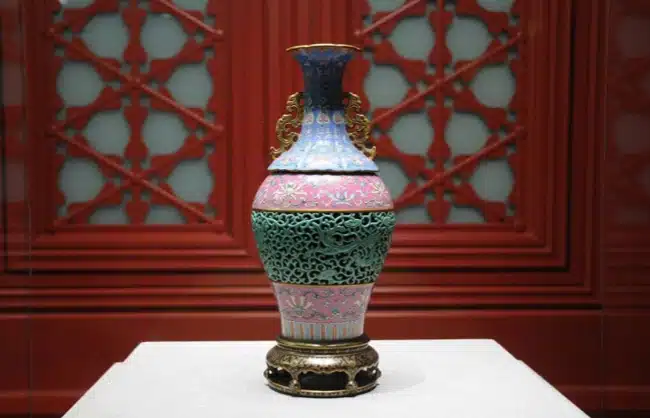
Porcelain, first developed during the Eastern Han Dynasty, is another major Chinese contribution to global culture. Chinese porcelain was highly valued in international trade, as this product showed how strength, smooth surface, and elegant appearance can all live in the same thing. For a long time, it was considered a luxury item in Europe, and the English word “china” even became synonymous with fine porcelain.
Ancient China also created remarkable mechanical inventions. One famous example is the Water-Powered Astronomical Clock Tower, designed by the Northern Song scientist Su Song in 1088. This large instrument combined astronomical observation, timekeeping, and mechanical automation. Historians often regard it as an early predecessor of mechanical astronomical clocks in Europe.

China’s “New Four Great Inventions”
The term “New Four Great Inventions” became popular in China in 2017. They refer to high-speed rail, mobile payments, bike sharing, and online shopping. The concept originated from a survey conducted by the Silk Road Research Institute at Beijing Foreign Studies University. They invited international students from 20 Belt and Road countries and asked these students to vote for the Chinese technologies and lifestyles they most wanted to take home.

In fact, even though we’re now calling them China’s “New Four Great Inventions”, they were not all originally invented in China. For instance, early mobile payments appeared in Finland, and bike sharing began in the Netherlands. Online shopping was also first proposed in the United Kingdom. However, they still shape parts of people’s impression of China, since China has led the world in large-scale adoption, innovation, and everyday application of these technologies.
High-speed rail has dramatically shortened travel time between cities in such a large country. Mobile payment allows people to complete transactions easily by scanning QR codes. Bike sharing offers a convenient and environmentally friendly solution for short-distance travel, while online shopping has transformed retail and logistics.

Although the term is largely a popular cultural expression, the “New Four Great Inventions” highlight how modern technology in China has influenced daily life and attracted global attention.
Travel through the Legacy of China’s Four Great Inventions with China Xian Tour
Chinese people’s creativity and imagination, and the impressive innovations they made, have become a bright star in China’s history. The Four Great Inventions, papermaking, printing, gunpowder, and the compass, represent some of the most influential achievements. Even though they were developed thousands of years ago, their lasting impact can still be sensed in the present world. They contributed not only to China’s development but also to the progress of the wider world, in terms of communication, navigation, warfare, and the spread of knowledge.
Today, China continues this spirit of innovation with the New Four Great Inventions, including high-speed rail, mobile payments, bike sharing, and online shopping, offering visitors a chance to experience both ancient achievements and modern ingenuity.
To better explore these historic and modern innovations, you can plan an in-depth travel through China. Cities like Beijing, Nanjing, and many Silk Road towns all show a great insight into these innovations. Choose China Xian Tour as your best travel partner, we offer the best customized itineraries and services that you would prefer, and our professional local guides will prepare everything for you from the beginning to the end. Contact us right now, and get ready for an unforgettable China tour!